


Choosing the wrong platform can hurt conversions. See how Shopify, Wix, and Squarespace differ in scaling, variants, and store usability.
Choosing a platform for your online store sounds simple at first. You compare design, pricing, and how easy it is to set up. But once your catalog grows, the real challenge begins. Products start having multiple sizes, colors, and styles, and it becomes harder to keep everything clear for shoppers.
The global e-commerce market size is projected to reach USD 155.98 trillion by 2033, which means more competition and higher expectations coming from customers. If people cannot quickly find or understand your product options, they leave.
This is where the choice between Shopify, Wix, and Squarespace starts to matter more than it seems. In this blog, we will discuss which platform actually supports growing stores and helps customers make faster buying decisions.
Overview
- Shopify, Wix, and Squarespace differ mainly in commerce depth: Shopify is built for full-scale selling systems, Wix for simple storefront creation, and Squarespace for visually curated, content-led product showcases with lighter commerce needs.
- Variant handling is the biggest functional gap between platforms, where Shopify supports structured scaling, Wix manages basic options easily, and Squarespace remains limited when product combinations or configuration complexity increase.
- Customer experience quality changes based on how products are displayed. Shopify allows more control over browsing flow, while Wix and Squarespace often rely on simpler product-page-first navigation that slows discovery.
- Long-term scalability depends on backend flexibility, where Shopify supports large catalogs and integrations. Meanwhile, Wix and Squarespace can become harder to manage efficiently as product volume and operations grow.
- Conversion performance is directly tied to clarity in variant selection and image mapping, where a more structured presentation reduces hesitation and improves decision speed across all three platforms.
Shopify vs Wix vs Squarespace: What Each Platform Offers
Choosing between these platforms usually comes down to how your store needs to function day-to-day. This could be product setup, variant handling, and how easily customers can find and buy what they want without confusion.
1. Shopify

Shopify is designed specifically for e-commerce, so everything revolves around selling efficiently. It handles large product catalogs, complex variants, and inventory tracking with ease. You also get built-in payments, shipping tools, and a strong app ecosystem, making it suitable for stores planning long-term growth.
2. Wix

Wix focuses on simplicity and design freedom. It’s easy to set up, with drag-and-drop editing and flexible layouts. While it supports e-commerce, managing large catalogs or complex product variants can become limiting, making it more suitable for smaller stores or beginners.
3. Squarespace

Squarespace is strong in visual design and content-driven websites. It works well for brands that rely on storytelling, portfolios, or curated product lines. Its e-commerce features are clean but relatively basic, which can restrict flexibility when handling multiple variants or scaling operations.
Now that the positioning is clear, let’s look at the real factors that impact e-commerce performance between these platforms.
Also Read: What Is a Color Swatch? A Practical Guide for Shopify Stores
Shopify vs Wix vs Squarespace: Key Factors That Decide Store Performance
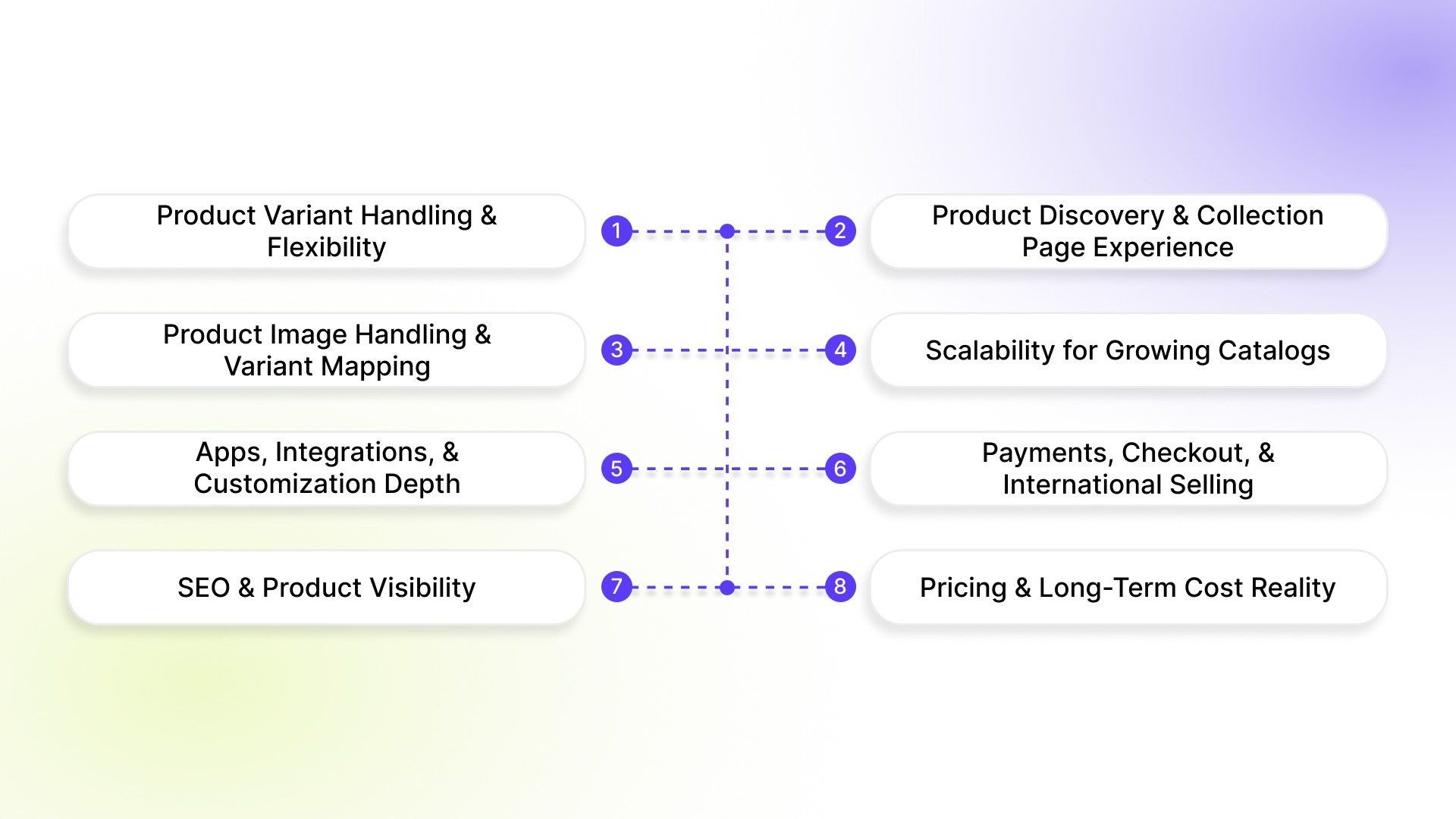
When comparing Shopify, Wix, and Squarespace, surface-level features like design and pricing don’t explain real performance differences. What actually matters is how each platform handles product structure, variant clarity, browsing experience, and scalability when stores start growing. The factors mentioned below directly affect how quickly customers find products and complete purchases.
1. Product Variant Handling and Flexibility
Shopify supports up to 100 variants per product with three options: size, color, or style. While that’s a hard limit, stores often extend it using product grouping or apps. Display formats can also be customized beyond dropdowns with the right setup.
Wix keeps variant setup simple, allowing options like size and color without much effort. This works well for small catalogs, but as combinations increase, managing them becomes harder. Display customization is limited, which can restrict how clearly options are presented.
Squarespace supports basic variants such as size or color, but the structure is minimal. It works for simple products, yet handling multiple combinations or complex setups is restrictive. Display options are limited, making it harder to scale variant presentation cleanly.
2. Product Discovery and Collection Page Experience
Shopify’s default setup shows products as single listings on collection pages, with variants hidden inside. However, with theme adjustments or apps, variants like colors can appear directly on collections, improving browsing speed and reducing unnecessary clicks for users.
Wix keeps collection pages visually clean, and in some cases allows basic variant previews like color options. However, deeper variant exploration still requires opening the product page, which adds steps when users want to compare multiple options quickly.
Squarespace focuses more on layout and presentation, with limited support for showing variants on collection pages. Most options remain inside product pages, which slows down browsing for stores with multiple variant choices.
3. Product Image Handling and Variant Mapping
Shopify links a single image to each variant by default, so selecting a variant updates the main image. Showing multiple images per variant or keeping galleries fully filtered usually needs theme tweaks or apps. Without that, galleries can feel mixed, especially for visual products.
Wix lets you assign images to variants, and the main image updates on selection. However, galleries are not strictly filtered per variant, so customers may still see unrelated images. This can make product pages feel slightly cluttered when multiple variants share one gallery.
Squarespace supports basic variant image changes, typically updating the main image when a variant is selected. However, it does not manage multiple images per variant in a structured way. As a result, galleries often include mixed images, which can reduce clarity for customers.
4. Scalability for Growing Catalogs
Shopify is built to handle large catalogs, including thousands of SKUs, without major structural changes. Bulk editing tools, inventory tracking, and app-based extensions help maintain performance as complexity grows, though very large stores often rely on additional optimization apps.
Wix can support growing catalogs, but performance and management become more noticeable as product volume increases. Bulk operations exist, but they are less advanced, and organizing large variant-heavy catalogs can start to feel slower and less efficient over time.
Squarespace works best for smaller, curated catalogs. It can handle standard product ranges smoothly, but as the SKU count and variant complexity increase, management becomes harder. Bulk handling and structural flexibility are limited, which can restrict long-term scalability for larger stores.
When Shopify stores scale and product catalogs grow, variant-heavy listings become harder to organize and present clearly. StarApps Studio helps structure variants, improve image mapping, and simplify product display for easier customer understanding.
5. Apps, Integrations, and Customization Depth
Shopify has a large app ecosystem covering almost every store's need, from variant display to SEO and automation. It also supports deeper customization through themes and APIs, making it easier to extend functionality as business requirements grow.
Wix offers an app market and developer tools that cover a wide range of website and basic e-commerce needs. While flexible for general use, deeper commerce-specific customizations, especially around complex workflows or advanced variant logic, are more limited compared to Shopify.
Squarespace provides essential built-in features with a smaller integration ecosystem. It keeps setups simple and stable, but third-party extensibility and advanced customization options are limited, which can restrict how far stores can be tailored as needs grow.
6. Payments, Checkout, and International Selling
Shopify supports a wide range of payment gateways and a highly optimized checkout system designed for conversion. With Shopify Payments (where available), it enables multi-currency pricing and localized checkout experiences through Shopify Markets, allowing stores to adapt pricing and currency by region.
Wix supports major payment providers and allows international transactions, with some multi-currency capabilities depending on region and setup. It works well for basic global selling, but localization and checkout customization remain more limited compared to Shopify.
Squarespace supports standard payment methods and a simple checkout flow, but international selling capabilities are more basic. Multi-currency support and localized checkout experiences are limited, making it better suited for domestic or smaller-scale global setups.
7. SEO and Product Visibility
Shopify provides strong SEO fundamentals with clean URL structures, editable meta titles and descriptions, and fast-loading pages. However, variants are not indexed as separate pages by default since they exist under a single product URL. Any variant-level SEO requires workarounds like separate listings or structured product setups.
Wix offers standard SEO controls such as editable URLs, meta tags, and basic indexing support. It performs well for general SEO needs, but product-level SEO depth is limited, especially when handling large catalogs or complex variant structures.
Squarespace is strong for content-driven SEO, like blogs and landing pages, with clean and structured URLs. For product pages, SEO capabilities are more basic, with limited flexibility in controlling indexing or creating deeper search visibility for individual product variants.
8. Pricing and Long-Term Cost Reality
Shopify starts at around $29/month for its Basic plan, but most growing stores gradually add paid apps for features like variant display, automation, or SEO improvements. This makes the real cost higher over time, but it also gives access to a very large ecosystem built for scaling without platform migration.
Wix starts at approximately $17/month for e-commerce plans, making it more affordable at the entry level since hosting and basic store features are bundled. Costs can increase when upgrading plans or adding apps, but they generally stay controlled unless advanced functionality is needed.
Squarespace typically ranges from around $23 to $49+ per month, depending on the plan. Pricing is predictable since most features are included, but limitations in advanced e-commerce functionality can lead to earlier platform constraints rather than cost scaling.
Having compared each platform across key areas, let’s directly see how Shopify, Wix, and Squarespace perform side by side.
Which Is Better for E-commerce: Shopify vs Wix vs Squarespace (Side-by-Side Comparison)
When comparing Shopify, Wix, and Squarespace for e-commerce, the key difference is how each platform handles growth, product complexity, and store control. Shopify is built for scaling online stores, Wix focuses on simplicity with flexible design, and Squarespace prioritizes clean visuals with lighter commerce features.
Here’s a clear side-by-side view of how they compare:

Now that we have a clear side-by-side view, let’s understand where each platform starts to show real-world limitations.
Where Shopify vs Squarespace vs Wix Starts to Break?
As stores grow beyond basic product listings, the differences between Shopify, Wix, and Squarespace become more visible in how they handle variants, catalog size, and operational flexibility. What works for a small store often starts to feel restrictive when product complexity and scaling demands increase, especially in areas like product structure, image handling, and workflow control.
1. Shopify Limitations
Shopify is strong for scaling commerce, but its default product setup has a few constraints. Variant selection is typically handled through dropdowns unless themes or apps are used to improve the experience. Image-to-variant mapping is also not fully automated by default and often requires configuration or third-party tools to keep galleries clean and fully aligned with selected variants.
2. Squarespace Limitations
Squarespace is effective for simple, design-led stores, but e-commerce depth is limited. Variant logic is basic, which makes it harder to handle complex product configurations. Integration options are also more restricted compared to larger commerce ecosystems, which can limit flexibility as business requirements expand.
3. Wix Limitations
Wix works well for smaller stores, but limitations become more visible as catalogs grow. Managing large numbers of products or complex variant combinations can feel less efficient compared to commerce-first platforms. Bulk management and structural flexibility are more limited, which can slow down operations for scaling stores.
Having seen limitations, let’s now decide which platform actually fits your store based on size, goals, and complexity.
Also Read: 7 Best Free Shopify Themes for 2026 That Convert Better
Which Platform Should You Choose: Wix vs Squarespace vs Shopify?
Choosing between Wix, Squarespace, and Shopify comes down to how complex your store is today and how much you expect it to grow. Each platform is built for a different stage of e-commerce maturity, from simple product listings to large-scale selling with advanced catalog and variant management.
Choose Wix if:
You’re launching a small online store with a limited number of products and want a fast setup without technical complexity. It works well when your priority is basic selling, simple variants, and design flexibility, rather than handling large catalogs or advanced e-commerce workflows.
Choose Squarespace if:
Your store is content-led, and design is the main focus, such as lifestyle brands, portfolios, or small curated product ranges. It supports basic e-commerce needs but is best suited for businesses where storytelling and visual presentation matter more than scaling product depth.
Choose Shopify if:
You’re building a serious e-commerce business with growing product catalogs, multiple variants, and a focus on conversions. It is designed for scaling stores that need stronger product management, better integration options, and the ability to handle complex selling setups over time.
Now that platform differences are clear, let’s understand why the product variant experience itself becomes a critical conversion factor.
Why Product Variant Experience Directly Impacts Conversions?
In online shopping, product variants decide how quickly a customer understands what they’re buying. It’s not just about offering options like size or color, but how clearly those options are presented and how smoothly a shopper can move between them. When variant presentation is unclear, customers hesitate, compare longer, and often exit before adding anything to the cart. This becomes more important in stores with multiple SKUs, where small UX friction compounds quickly.
Here’s how a variant experience directly shapes buying behavior at a practical level:

- Faster choice recognition: Clear variant layouts help shoppers identify the right option instantly without scanning long dropdown lists or multiple clicks.
- Visual comparison speed: Swatches or images allow users to compare colors or styles side by side instead of mentally decoding text labels.
- Reduced purchase uncertainty: When selected variants match displayed images accurately, customers feel more confident about what will arrive.
- Lower mobile friction: On mobile screens, simplified variant interaction reduces scrolling effort and prevents accidental drop-offs during selection.
- Better product clarity at scale: In large catalogs, structured variants prevent confusion when multiple similar products or options exist within one listing.
Having understood how variant experience impacts buying decisions, let’s see how Shopify stores can improve this using StarApps Studio.
Also Read: Shopee vs Shopify: Which Platform Will Skyrocket Your Sales in 2025
How StarApps Studio Improves Shopify Variant Experience?
Shopify provides a solid foundation for e-commerce, but a variant presentation can feel limited when product complexity increases. Stores with multiple colors, sizes, or style-based variations often rely on basic dropdowns or inconsistent image setups, which slows down product comparison and create confusion during selection. This becomes more noticeable as catalogs scale, and customers expect faster visual clarity.
StarApps Studio directly solves this on Shopify by improving how variants are displayed, selected, and connected to product images, making the entire shopping experience more structured and easier to understand.
Here’s how StarApps Studio tools improve product clarity:
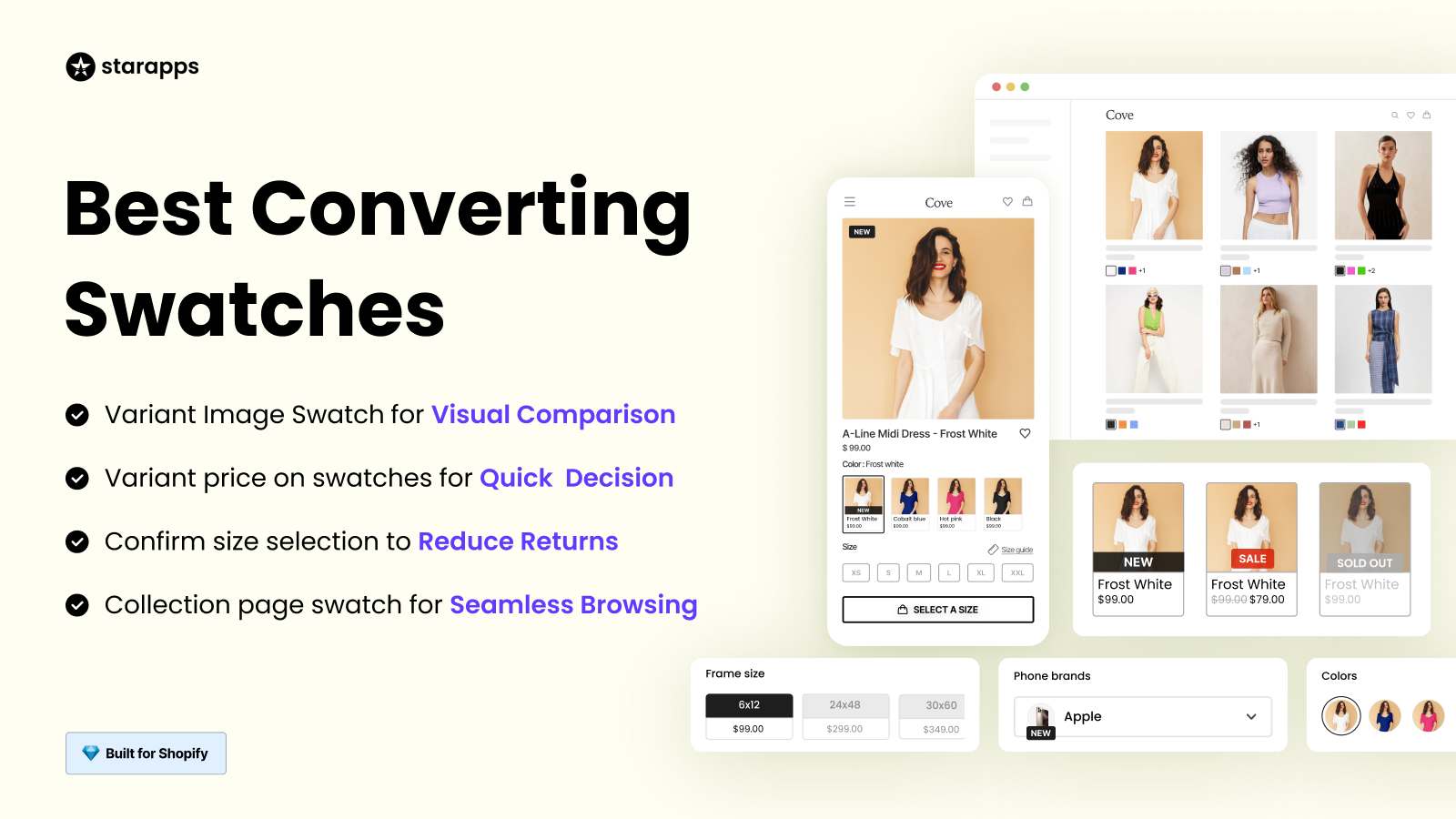
- Swatch King: Replace dropdown-based selection with visual swatches like colors, images, or buttons so customers can compare variants instantly and make quicker decisions without opening menus or scrolling through lists.
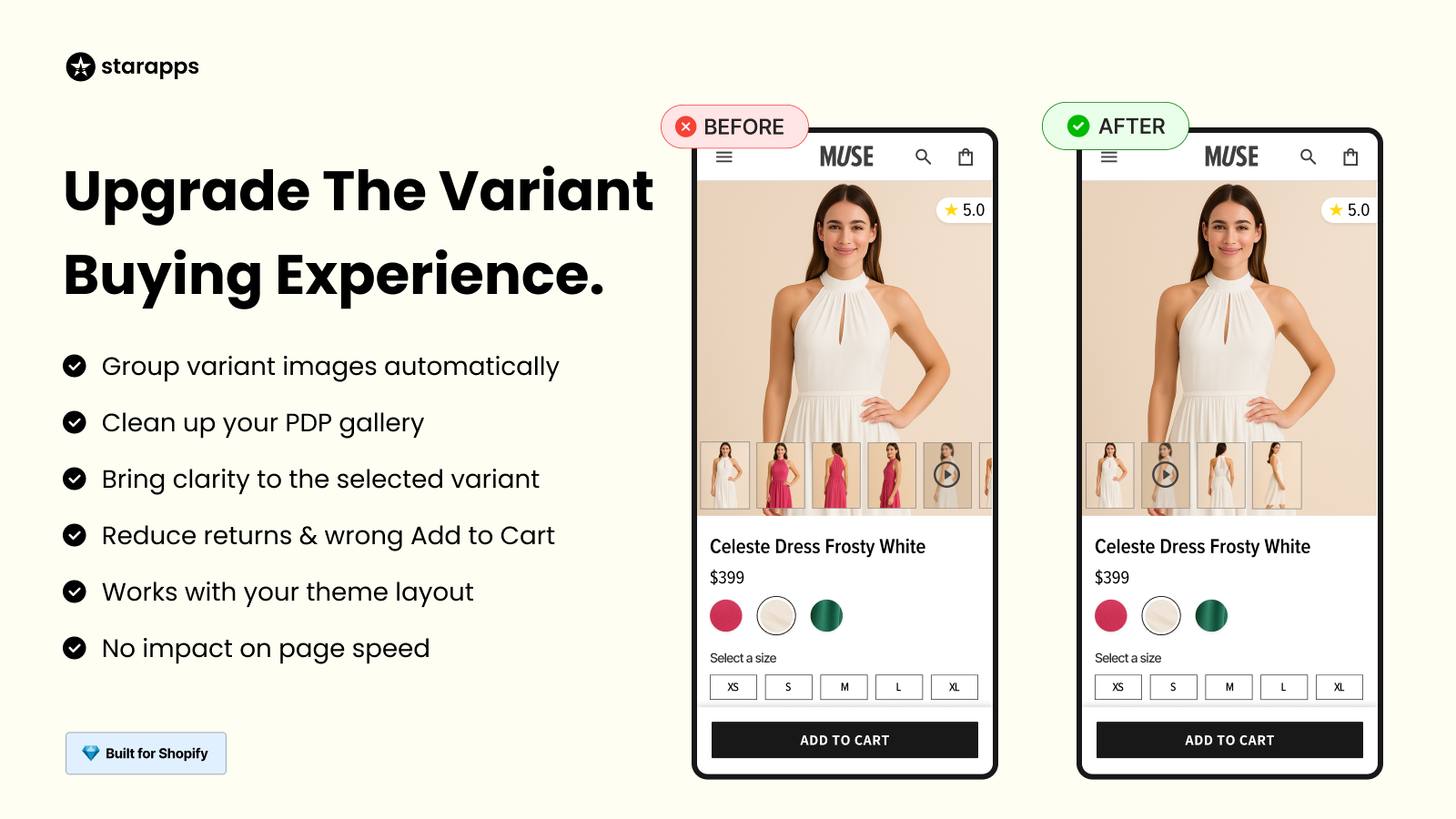
- Variant Image Automator: Automatically link product images to specific variants so only relevant visuals are shown when a selection changes, removing mixed galleries and making product presentation cleaner and more accurate.
- Combined Listings: Group related variants or products into structured listings so shoppers can browse similar options more easily on collection pages without losing context or switching between multiple product pages.
Together, these tools improve clarity, reduce selection friction, and help Shopify stores deliver a smoother variant experience that supports faster buying decisions.
Conclusion
Choosing between Shopify, Wix, and Squarespace depends less on design preference and more on how your store is expected to grow. Shopify is built for scaling product-heavy stores, Wix works well for simple setups, and Squarespace fits content-led, design-focused brands. The real difference shows up when product variants, catalog size, and customer clarity start affecting conversions and daily store management.
As stores grow, handling variants clearly becomes critical, and this is where many Shopify merchants improve performance using tools from StarApps Studio. Solutions like Swatch King, Variant Image Automator, and Combined Listings help improve how products are displayed, selected, and understood, making shopping faster and less confusing for customers.
If you are planning to improve your Shopify store experience or reduce friction in product selection, connect with us today to explore how your store can be structured for better clarity and conversions.
FAQs
1. Is Shopify actually worth the cost compared to Wix, Squarespace, etc.?
Shopify is worth the cost for growing e-commerce stores because it is built for scaling, inventory control, and advanced selling tools. Wix and Squarespace are cheaper, but they lack Shopify’s depth in commerce features, automation, and long-term scalability.
2. What does Shopify offer that Wix doesn't?
Shopify offers a stronger e-commerce infrastructure, including advanced inventory management, multi-channel selling, better scalability, and a much larger app ecosystem. Wix is more website-focused, while Shopify is purpose-built for handling complex online stores and higher sales volume.
3. Which one is better, Shopify, Wix or Squarespace, in terms of website building and navigation speed?
Wix is generally easier for website building due to its drag-and-drop design, while Shopify offers better performance and smoother store navigation for e-commerce. Squarespace is balanced but more design-focused than commerce-focused. Shopify performs better for structured online stores.
4. What is easier, Shopify or Wix?
Wix is easier for beginners because it has a highly visual drag-and-drop editor and a simpler setup. Shopify has a learning curve, but it becomes easier once set up, especially for managing orders, products, and scaling an online store.
Heading

End-to-end traceability
To ensure regulatory compliance, you must have a complete overview of your products from production to shipping. Book a demo to see how Katana can give you full visibility of your operations.
.png)

.svg)

.svg)

.svg)
.png)