
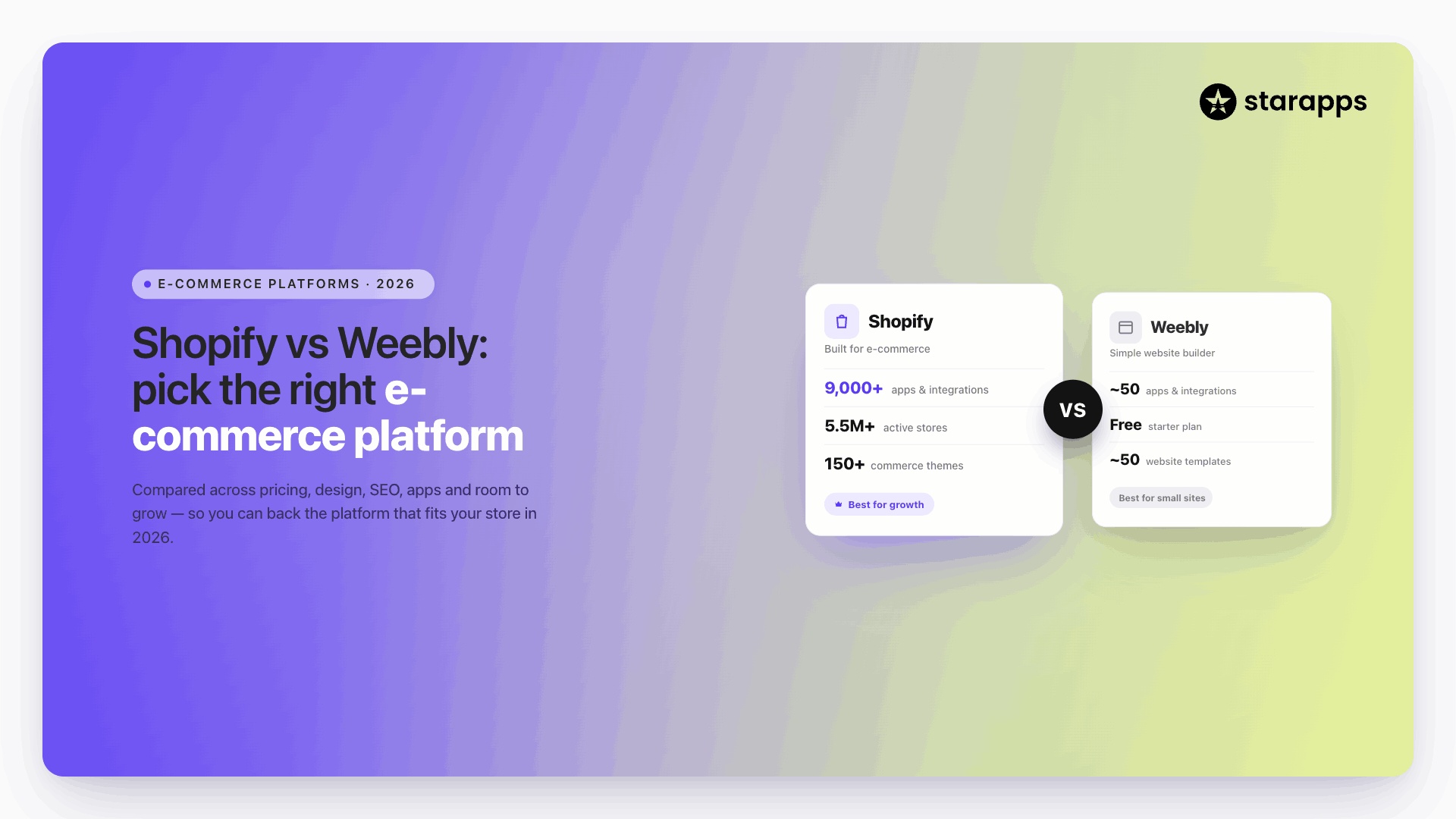

Shopify vs Weebly compared across pricing, design, SEO, apps, and growth features. Find the right platform for your online store in 2026.
Global eCommerce sales are projected to reach nearly $6.9 trillion in 2026, creating more opportunities than ever for businesses selling online. As competition grows, the platform behind your store can influence everything from customer experience and product management to marketing and long-term growth.
When comparing Shopify vs Weebly, both platforms serve different types of businesses. Shopify is built specifically for eCommerce and powers millions of merchants worldwide, while Weebly focuses on simple website creation with basic online selling features. The right choice depends on your product catalog, growth plans, and operational needs. In this guide, you'll discover how the two platforms compare across pricing, design, usability, SEO, apps, and scalability so you can choose the option that best supports your business goals.
TL;DR
- Shopify is built specifically for e-commerce businesses that plan to grow product catalogs, sales channels, and traffic.
- Weebly works best for small websites, local businesses, and beginners who need simple online selling.
- Shopify offers a larger app ecosystem, stronger inventory controls, and deeper customization options.
- Weebly is easier to launch initially, but may feel limiting as product counts and store complexity increase.
- If long-term growth, advanced merchandising, and product variant management matter to your business, Shopify offers more room to expand.
What Is Shopify?
Shopify is a dedicated e-commerce platform built to help merchants sell products online, in person, and across channels. It launched in 2006 and now powers over 5.54 million active stores globally.
What sets it apart is depth. Shopify gives you a full commerce stack: product management, checkout, payments, shipping, analytics, and a massive app ecosystem. You can run a small boutique or a high-volume DTC brand on the same platform.
It supports multiple sales channels, your own storefront, social media, marketplaces, and wholesale. Every plan includes SSL, hosting, and 24/7 support. For merchants serious about growth, Shopify is the platform most comparable to a fully managed commerce operating system.
What Is Weebly?
Weebly started as a drag-and-drop website builder. In 2018, Square acquired it, and since 2024, Square has officially shifted focus to Square Online, its own e-commerce product built on Weebly's foundation.
What this means for you: Weebly, as a standalone platform, is no longer receiving major updates. New users are redirected to Square Online, which keeps the simple drag-and-drop editing experience but leans heavily into Square's payment ecosystem.
Weebly/Square Online works well if you need a basic storefront fast, sell locally, or already use Square for in-person payments. It has a free plan, a clean interface, and a short setup time. But its app store has roughly 50 integrations versus Shopify's 9,000+, and its e-commerce tools are limited once you need anything beyond the basics.
Shopify vs Weebly: A Detailed Platform Comparison
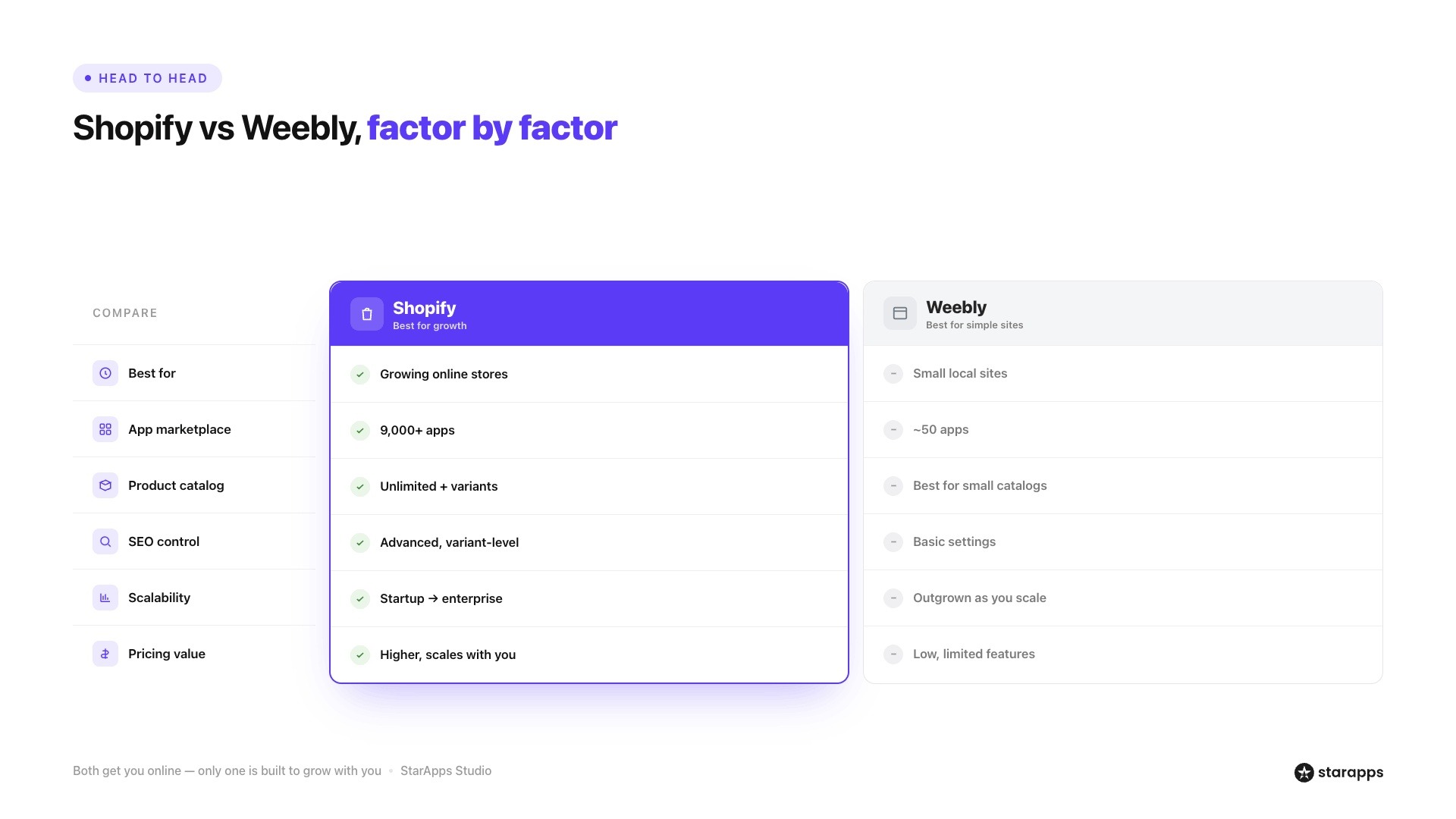
Here is a side-by-side look at how both platforms compare on the factors that matter most.
Platform Ratings and Merchant Adoption
Shopify
- Powers over 5.5 million active stores globally, making it one of the most widely used eCommerce platforms.
- Maintains strong ratings across major review platforms because of its commerce-focused features.
- Trusted by startups, DTC brands, wholesalers, and enterprise merchants.
- Supported by a large developer, partner, and merchant community.
- Receives frequent platform updates focused on selling, checkout improvements, and store performance.
Weebly
- Maintains positive ratings among small business owners and first-time website creators.
- Popular with local businesses that need a simple online presence.
- Smaller merchant community compared to Shopify.
- Receives fewer commerce-focused updates since Square shifted focus toward Square Online.
- Less commonly used by large product-based brands.
Best: Shopify wins because it supports a much larger merchant ecosystem and continues investing heavily in commerce infrastructure. Businesses benefit from stronger support resources, better scalability, and long-term platform development.
Pricing Structure and Long-Term Costs
Shopify
- Supports unlimited products across all paid plans.
- Includes advanced inventory management, analytics, and multichannel selling tools.
- Allows businesses to expand functionality through thousands of apps.
- Reduces the need for platform migration as sales volume grows.
Weebly
- Lower monthly costs for businesses with simple requirements.
- Suitable for small stores with limited catalogs.
- Important commerce features become available only on higher plans.
- Businesses often hit feature limitations as operations become more complex.
Best: While Shopify costs more upfront, it usually provides better long-term value. Merchants avoid many of the limitations that often force growing businesses to migrate platforms later.
Ease of Use and Store Setup Experience
Shopify
- Guided onboarding simplifies store creation.
- Step-by-step setup covers products, payments, shipping, and taxes.
- Dashboard is organized specifically around online selling.
- Most merchants can launch a functional store within one day.
- Extensive tutorials and documentation reduce the learning curve.
Weebly
- Uses a beginner-friendly drag-and-drop builder.
- Website setup feels simple for non-technical users.
- Faster initial launch for basic websites.
- Less structured for managing large product catalogs.
- Product management becomes harder as inventory grows.
Best: Shopify becomes easier to manage once product counts, orders, and marketing activities increase. Its workflow is built around eCommerce rather than general website creation.
Theme Selection and Design Flexibility
Shopify
- Offers more than 150 professionally designed themes.
- Themes are built specifically for product discovery and conversions.
- Mobile-first designs perform well across devices.
- For stores with many variants, Swatch King and Variant Image Automator create a clearer shopping experience without custom code.
Weebly
- Provides around 50 website-focused templates.
- Simple visual customization options.
- Good for informational websites and small storefronts.
- Fewer advanced merchandising layouts.
- Limited flexibility for complex product catalogs.
Best: Shopify gives merchants stronger design control and more commerce-focused layouts. This becomes especially important for brands selling large product collections.
Website Editors and Content Management
Shopify
- Uses a section-based visual editor.
- Allows merchants to customize collection pages, product pages, and landing pages.
- Supports reusable content sections across the store.
- Compatible with advanced page-builder apps.
- Provides Liquid access for custom development needs.
Weebly
- Uses true drag-and-drop editing.
- Allows placement of elements almost anywhere on a page.
- Easier for creating simple business websites.
- Less structured for large-scale product management.
- Limited control over advanced commerce layouts.
Best: Shopify produces cleaner and more consistent storefronts. This structure becomes valuable when managing hundreds of products and multiple collections.
App Marketplace and Extension Capabilities
Shopify
- Provides access to more than 9,000 apps.
- Supports subscriptions, reviews, loyalty programs, upsells, SEO, inventory management, and automation.
- Specialized solutions from developers like StarApps Studio, such as Swatch King and Variant Title King, enhance product variant usability beyond Shopify’s native tools.
- Offers powerful APIs for custom functionality.
- Supports advanced product merchandising through specialized apps.
Weebly
- Offers a much smaller extension marketplace.
- Covers basic marketing and website functionality.
- Strong connection with Square payment services.
- Limited options for advanced merchandising and product management.
- Fewer tools available for scaling operations.
Best: Shopify's app ecosystem is one of its biggest strengths. Businesses can continuously expand store functionality without rebuilding their entire storefront as requirements change.
SEO Features and Organic Search Visibility
Shopify
- Includes editable meta titles, descriptions, URLs, and redirects.
- Supports advanced SEO applications and automation tools.
- Handles large product catalogs efficiently.
- Allows merchants to create SEO-focused collection structures.
- Supports variant-level SEO improvements through specialized apps.
Weebly
- Includes basic SEO settings.
- Suitable for small local websites.
- Limited automation capabilities.
- Fewer advanced optimization tools.
- Less flexibility for large-scale organic growth strategies.
Best: Shopify offers stronger SEO capabilities for growing eCommerce brands. Merchants can build scalable search strategies without running into platform limitations.
Scalability and Business Growth Potential
Shopify
- Designed for businesses ranging from startups to enterprise brands.
- Supports international selling and multiple storefronts.
- Handles high traffic volumes and large inventories.
- Continuously adds new commerce features.
- Suitable for brands planning long-term growth.
Weebly
- Best suited for small businesses and local sellers.
- Works well for limited product catalogs.
- Handles basic online selling effectively.
- Less suitable for large inventories and advanced workflows.
- Businesses frequently outgrow the platform.
Best: Shopify is built for growth. Whether you sell 50 products or 50,000, the platform provides the infrastructure, app ecosystem, and operational flexibility needed to support expansion without major disruptions.
Shopify vs Weebly: Pros and Cons
No eCommerce platform is perfect. Both Shopify and Weebly have strengths that make them appealing to certain businesses, along with limitations that may affect your ability to grow. Understanding these trade-offs can help you choose a platform that supports your goals today and several years from now.
Shopify Pros
- Built specifically for eCommerce: Built specifically for eCommerce, Shopify focuses every feature on helping merchants sell products efficiently.
- Extensive app ecosystem: Access over 9,000 apps for SEO, marketing, subscriptions, and customer retention.
- Strong inventory and product management: Shopify efficiently manages large catalogs with tools for inventory tracking, organization, and variants.
- Excellent scalability: The platform supports businesses at every stage, from startup stores to enterprise brands processing thousands of orders daily.
- Advanced SEO capabilities: Provides SEO controls for URLs, redirects, metadata, and stronger search visibility management.
Shopify Cons
- Higher monthly investment: Shopify's pricing is higher than beginner-focused website builders, especially when businesses add premium apps.
- App costs can add up: While apps add flexibility, merchants may pay additional monthly fees for specialized functionality.
- Learning curve for advanced features: Basic store setup is simple, but advanced customization and automation require time to learn.
- Customization may require developer assistance: Some design and functionality changes may require knowledge of Shopify's Liquid framework or support from a developer.
Weebly Pros
- Easy for beginners: Weebly's drag-and-drop editor is simple to learn and allows users to create websites without technical knowledge.
- Free plan available: Businesses can start with minimal upfront costs, making it attractive for testing ideas or launching small projects.
- Quick website setup: Most users can create a basic website and start selling products within a short period.
- Strong Square integration: Businesses already using Square for in-person sales benefit from a connected payment and POS ecosystem.
- Good for small catalogs: Stores with a limited number of products can manage their inventory without needing advanced tools.
- Flexible page editing: The freeform editor allows users to position content elements with fewer layout restrictions.
Weebly Cons
- Limited eCommerce functionality: The platform focuses more on website creation than advanced online selling.
- Small app marketplace: Merchants have far fewer options when they need additional marketing, SEO, inventory, or merchandising tools.
- Limited customization options: Compared to Shopify, Weebly offers less flexibility for product pages, checkout experiences, and advanced store functionality.
- Basic SEO capabilities: While sufficient for small websites, the platform lacks many advanced SEO features that growing stores often need.
- Lower scalability: Businesses frequently outgrow Weebly and migrate to more commerce-focused platforms as sales increase.
Verdict
For local businesses, personal websites, and small online stores, Weebly offers a simple and affordable starting point. For businesses focused on long-term eCommerce growth, larger product catalogs, stronger SEO, and advanced selling capabilities, Shopify is a better choice.
Real-World Use Cases of Shopify and Weebly
Shopify- A fashion brand scaling variants
A mid-sized apparel brand selling 300 SKUs across 12 colors and 6 sizes needed clean product pages and fast variant switching. On Shopify, they used Swatch King to display color options visually on collection pages and Variant Image Automator to auto-assign the right images per variant. Customers stopped landing on the wrong color. Add-to-cart rates improved within weeks of launch.
Weebly- A local bakery selling pre-orders
A bakery owner with 15 products needed a simple site to accept pre-orders for weekend pickup. Weebly's free plan was enough to get started. Square's payment integration handled checkout without extra setup. No app store, no complex variants, just a clean, affordable storefront that did the job.
How to Choose Between Shopify and Weebly?
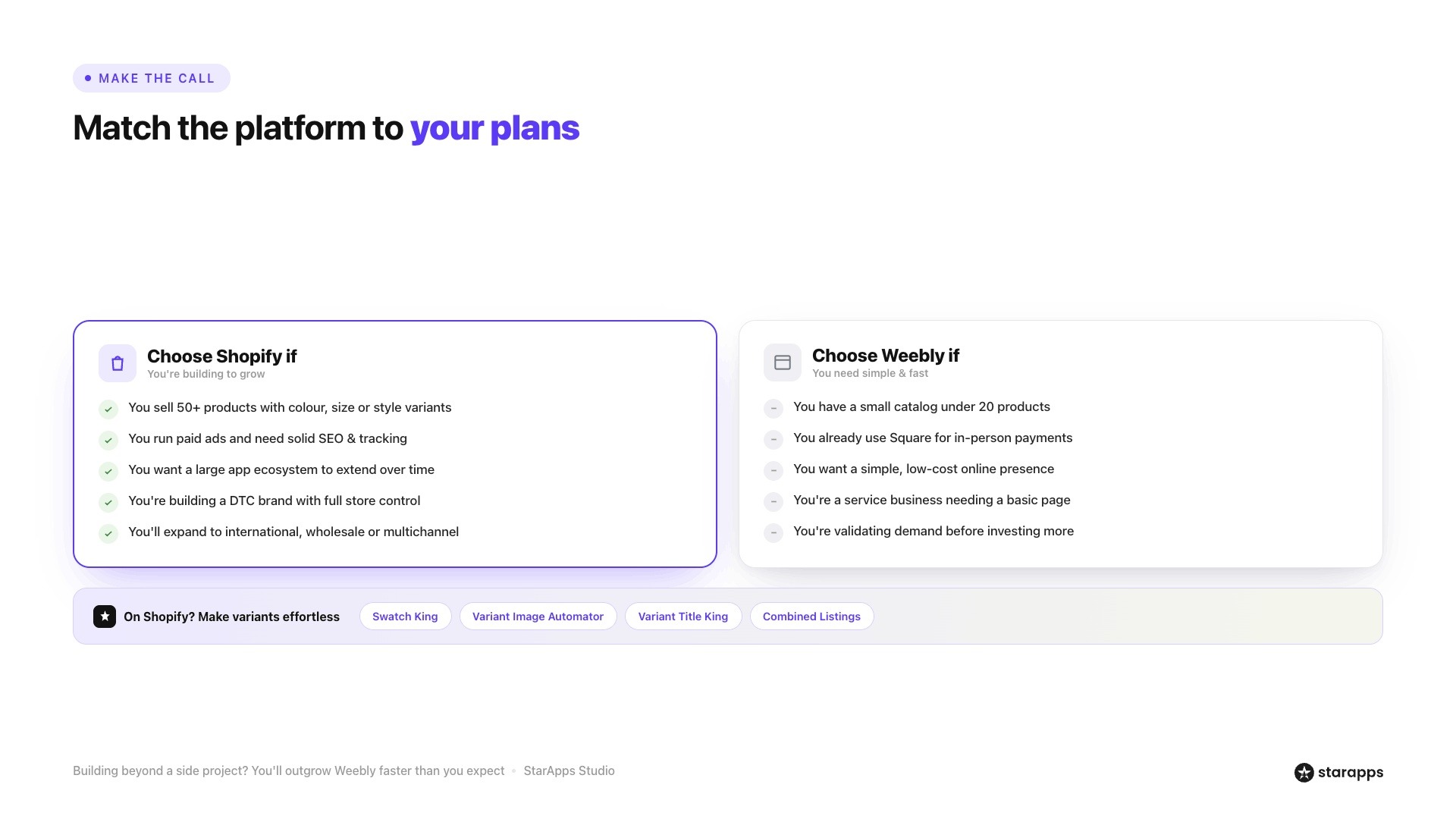
The right platform depends on where your business is today and where you want it to go. Both can get you online, but they stop being equal the moment you start thinking about growth, product complexity, or customer experience. Here's a clean way to think about it.
Choose Shopify if:
- You're selling 50+ products, especially with color, size, or style variants
- You plan to run paid ads on Meta, Google, or TikTok and need solid SEO and tracking infrastructure
- You want access to a large app ecosystem to extend store functionality over time
- You're building a DTC brand and need full control over product pages, checkout, and customer data
- You plan to expand into international markets, wholesale, or multi-channel selling
- You want 24/7 support and a platform that receives regular updates and new features
Choose Weebly if:
- You have a small catalog (under 20 products) with no complex variant needs
- You already use Square for in-person payments and want a fast, connected online storefront
- Your goal is a simple, low-cost presence, not a high-growth e-commerce operation
- You're a service-based business that needs a basic product or booking page
- You're just getting started and want to validate demand before investing in a full platform
The honest answer for most product-focused sellers is this: if you're building anything beyond a side project, you'll outgrow Weebly faster than you expect. Starting on Shopify avoids a disruptive migration later and gives you the tools to compete from day one.
How to Optimize Your Chosen Platform for Better Results?
If you've chosen Shopify, you've picked a platform built for selling. But the gap between a functional store and a high-converting one comes down to how well you handle product presentation, variant display, and on-page experience.
Out of the box, Shopify handles the basics. What it doesn't solve natively is the complexity of managing many variants cleanly, showing the right images, the right titles, and the right descriptions per variant without manual work. That's where StarApps Studio's tools come in.
Here are the key apps that directly address those gaps:
Swatch King- Variant Options Swatch King
Customers who can't see their options clearly don't buy. Swatch King replaces plain dropdown menus with visual selectors so shoppers see exactly what they're choosing.
How it optimizes your store:
- Shows color, texture, or image-based swatches directly on collection pages.
- Hides out-of-stock variants automatically, no dead ends for customers.
- Displays price differences per variant for transparency.
- Supports unlimited variants beyond Shopify's default cap.
- Prevents add-to-cart errors by requiring a variant selection first.
SA Variant Image Automator
Customers who can't see their options clearly don't buy. Swatch King replaces plain dropdown menus with visual selectors so shoppers see exactly what they're choosing.
How it optimizes your store:
- Shows color, texture, or image-based swatches directly on collection pages.
- Hides out-of-stock variants automatically, no dead ends for customers.
- Displays price differences per variant for transparency.
- Supports unlimited variants beyond Shopify's default cap.
- Prevents add-to-cart errors by requiring a variant selection first.
Variant Title King
Customers second-guess their order when the product title doesn't reflect what they selected. Variant Title King solves this by updating the product title in real time based on the customer's choice.
How it optimizes your store:
- Dynamically updates titles when a variant is selected.
- Displays color, size, SKU, or vendor info in the product title.
- Reduces return rates caused by ordering the wrong variant.
- Works with all Shopify themes and multilingual stores.
- Integrates with other StarApps apps for a consistent experience.
SA Variants: Combined Listings
Shopify groups all variants under a single product page by default. This limits discoverability in search and filters. SA Variants: Combined Listings treats each variant as its own listing.
How it optimizes your store:
- Displays each variant as a separate listing on collection pages.
- Gives every variant a unique URL, title, and image for better SEO.
- Improves filter and search results by variant-specific attributes.
- Enables side-by-side comparison between variants.
- Keeps variants linked across product pages for a consistent catalog view.
Together, these four apps address the areas where Shopify falls short by default: visual variant selection, image management, title clarity, and variant-level discoverability. Used together, they help your store perform like a premium DTC brand without requiring a developer.
Final Thoughts
Shopify vs Weebly is not a close race for most online sellers. Weebly works for a specific, limited use case: simple local stores, micro-businesses, and sellers already tied into the Square ecosystem. If that's you, it does the job at a low cost.
For anyone selling physical products, managing variants, running ads, or planning to grow, Shopify is the clear choice. Its infrastructure, app ecosystem, and commerce-first design are built for exactly that. And when you pair it with the right tools from StarApps Studio, your store gets the product experience customers expect from brands they trust.
Reach out to StarApps Studio to explore how our tools can strengthen your Shopify store and help you grow confidently.
FAQs
1. Is Shopify better than Weebly for large product catalogs?
Yes. Shopify handles large inventories more effectively. Its product management tools, app ecosystem, and merchandising features support stores with thousands of products and variants. Businesses selling apparel, beauty products, or electronics often benefit from Shopify's catalog management capabilities.
2. Is Weebly still a good option in 2026?
Weebly remains a practical option for beginners, local businesses, and small online stores. It offers simple website creation and Square connectivity. Businesses needing advanced selling features may eventually outgrow the platform.
3. Which platform is easier for beginners?
Weebly is generally easier for beginners because of its drag-and-drop editor and simplified setup process. Shopify requires slightly more setup but provides stronger selling tools once your business grows.
4. Does Shopify offer better SEO features than Weebly?
Shopify provides stronger SEO flexibility, especially for larger e-commerce stores. Merchants can expand SEO capabilities through apps, structured product pages, variant-specific listings, and advanced product management tools.
5. Can I migrate from Weebly to Shopify later?
Yes. Many businesses start with simpler platforms and move to Shopify as product counts and sales increase. Before migrating, review product data, URL structures, images, and SEO settings to reduce traffic disruptions during the transition.
Heading

End-to-end traceability
To ensure regulatory compliance, you must have a complete overview of your products from production to shipping. Book a demo to see how Katana can give you full visibility of your operations.
.png)

.svg)

.svg)

.svg)
.png)