
14 Proven Tips to Boost Revenue During BFCM 2026 and Maximize Sales

Boost BFCM revenue with proven strategies! Engage customers using hyper-personalization, gamification, and optimized experiences. Click to increase sales now!
Black Friday and Cyber Monday have become the most critical sales periods for online retailers. In 2025, Shopify merchants generated $14.6 billion in sales over BFCM weekend, representing a 27% increase from the previous year. Sales peaked at $5.1 million per minute on Black Friday, with 81 million customers worldwide making purchases from Shopify-powered brands.
The stores that achieved record revenue didn't simply offer larger discounts. They built superior shopping experiences, eliminated friction at critical conversion points, and executed comprehensive strategies across every customer touchpoint.
This guide provides a complete framework for BFCM 2026 preparation. You'll discover what worked in 2025, which tactics failed, and the exact steps to turn next year's shopping event into your most profitable period.
Key Takeaways
- BFCM 2026 success depends on planning early, removing friction, and optimizing every step of the customer journey.
- Personalization, genuine urgency, and clear product pages directly increase conversions and average order value.
- Mobile-first shopping, multi-channel marketing, and localized experiences are critical to capture global buyers.
- Avoid common operational mistakes, such as ignoring inventory, neglecting site speed, or running static offers.
- Tools like StarApps Studio help streamline variants, images, and descriptions, turning product clarity into higher BFCM revenue.
What 2025 BFCM performance reveals for 2026 preparation
The 2025 BFCM weekend showed that demand remains strong, but shopper behavior is evolving. Understanding these shifts is critical for planning next year’s strategy. Key insights from last year highlight where merchants succeeded, where friction cost sales, and what 2026 shoppers will expect:
- Record-breaking merchant performance: Over 94,900 Shopify merchants hit their highest single-day revenue ever, showing that peak-season growth is still attainable.
- High buyer commitment: Average cart value reached $114.70, meaning shoppers came prepared to spend and expected a smooth experience.
- Global shopping behavior: Cross-border orders accounted for 16% of total sales, underscoring the importance of international demand.
- Mobile dominance: 63 percent of Cyber Monday purchases were made on mobile, confirming that phones are now the primary channel for BFCM conversions.
- Price awareness and skepticism: 57 percent of shoppers questioned BFCM pricing, showing buyers research ahead and resist fake urgency tactics.
Taken together, these trends point to a more informed, mobile-first, and selective shopper. Success in 2026 depends on anticipating these expectations and removing friction wherever possible. Brands that plan with these insights will capture scale, while those relying on assumptions will compete solely on discounts.
14 Proven Tips to Boost Revenue in BFCM 2026
Revenue growth during BFCM requires systematic optimization across the entire customer journey. The framework below addresses each critical touchpoint from initial awareness through post-purchase retention.
1. Start Planning Early With a Pre-BFCM Revenue Ramp-Up
Begin your BFCM preparation in October. The brands that dominated 2025 built anticipation and captured high-intent shoppers weeks before deals launched.
Focus on email and SMS list building throughout October. Create exclusive access opportunities that give subscribers compelling reasons to join your list. These contacts become your most valuable asset when deals go live.
Things you can do:
- Launch teaser campaigns by mid-October that build curiosity without revealing full offers.
- Create tiered early access for loyal customers and email subscribers.
- Test your complete tech stack, including payment processors, checkout flows, and mobile responsiveness.
- Confirm inventory availability and supplier timelines to prevent stock-outs.
- Build countdown sequences and preview content that keep engagement high.
2. Use Hyper-Personalization to Increase AOV
Personalization directly impacts average order value by showing shoppers products they actually want to buy. When someone sees a bundle built around items they've been viewing, conversion probability increases significantly.
Implementation steps:
- Deploy AI-powered recommendation engines across product pages and checkout based on real-time behavior.
- Build dynamic bundles that reflect browsing history and product affinity.
- Implement segmented discounting that varies by customer type and purchase history.
- Display recently viewed items and complementary product suggestions.
- Personalize email and SMS campaigns with unique product recommendations per recipient.
3. Create Genuine Urgency & Scarcity
Fake countdown timers and misleading stock indicators have trained consumers to distrust urgency tactics. Authentic urgency requires truthful messaging about stock levels and time-limited offers. When you tell customers a product has limited availability, that information must be accurate.
Steps to follow:
- Display real-time stock-based urgency with low-stock counters tied to actual inventory.
- Add best-seller tags and trending indicators to high-velocity products.
- Use category-specific timers rather than arbitrary global countdowns.
- Provide genuine early access to VIP customers hours before the public launch.
- Maintain transparency about deal end times and honor those deadlines without extensions.
4. Optimize Your Product Pages for BFCM Conversions
Product pages serve as the final decision point before purchase. Poor design creates friction and confusion precisely when you're closest to converting a visitor.
During BFCM, shoppers compare multiple stores simultaneously. Your product pages must answer questions faster than competitors to capture the sale.
You should:
- Display product options and variants clearly with color swatches, size selectors, and visual comparisons.
- Provide high-quality images from multiple angles, including lifestyle shots showing real-world use.
- Add comparison views for products with multiple variants.
- Structure descriptions with scannable bullet points highlighting key features, materials, and benefits.
- Include prominent trust signals such as shipping timelines, return policies, security badges, and FAQ sections.
- Position social proof, including review counts, ratings, and customer photos, near the add-to-cart button.
To make this easier and faster, tools like StarApps Studio can help you manage variants, images, and swatches efficiently, ensuring every product page is clear, accurate, and optimized for BFCM conversions.
5. Improve Mobile & Checkout Experience to Reduce Drop-Offs
With 81% of consumers planning to use mobile shopping apps during BFCM, mobile optimization determines whether you capture or lose sales. Your mobile experience must exceed desktop in speed and simplicity.
Action Plan:
- Reduce checkout to the minimum required steps.
- Enable one-click payment methods, including Shop Pay, Apple Pay, and Google Pay.
- Add sticky add-to-cart buttons that remain visible during scrolling.
- Simplify mobile navigation with clear categories and prominent search.
- Compress images and minimize scripts to reduce load times.
- Remove unnecessary checkout fields and enable auto-fill wherever possible.
6. Use Tiered Rewards, Smart Bundles & Value-Based Incentives
Flat discounts are the least profitable way to drive sales. Tiered rewards and value-based incentives encourage larger orders while protecting margins better than percentage-off deals.
When shoppers see they're close to unlocking better rewards, they add products to reach that threshold. This increases average order value without requiring deep discounting.
Steps to follow:
- Structure spend-more-save-more tiers that incentivize larger purchases.
- Build value-based bundles with naturally complementary products.
- Offer bonus gifts at specific spend thresholds that provide perceived value at low cost.
- Add mystery gifts or unlockable surprises for orders exceeding target amounts.
- Display progress bars during checkout to show proximity to the next reward tier.
These tactics give shoppers control over their rewards, making increased spending feel earned rather than manipulated.
7. Add Gamification to Make BFCM More Fun & High-Converting
Shopping fatigue sets in quickly during BFCM as consumers scroll through identical promotional banners. This is why effective gamification is needed to create memorable moments that increase engagement and conversion without feeling gimmicky.
How to execute:
- Add spin-to-win pop-ups offering random discounts in exchange for email capture.
- Create rewards-based missions that guide shoppers through your site.
- Use progress bars showing proximity to unlocking free shipping or bonus gifts.
- Implement scratch-off reveals for mystery discounts on product pages.
- Add point multipliers for specific actions during limited time windows.
Keep gamification simple and ensure rewards justify the interaction required.
8. Harness Multi-Channel Marketing (Where Your Shoppers Actually Are)
Your customers engage with multiple platforms throughout their day. If you only advertise on one or two channels, you miss the majority of potential buyers.
Opt for multi-channel marketing and target platforms where your specific audience spends time, with messages tailored to each platform's usage patterns.
How to put this into practice:
- Run TikTok ads featuring user-generated content that feels native to the platform.
- Enable Instagram Shopping and Facebook Shops for in-app purchases.
- Deploy retargeting campaigns based on browsing depth and cart abandonment.
- Send coordinated email and SMS campaigns that complement rather than duplicate each other.
- Create platform-specific content optimized for how users engage with each channel.
Coordination across channels creates multiple touchpoints that guide shoppers toward purchase without overwhelming them.
9. Localize Deals & Experiences for Global Audiences
Cross-border orders represented 16% of global BFCM 2025 sales, yet many stores display US prices in USD to all visitors. This creates confusion and friction for international buyers.
Localize the entire shopping experience for different regions so consumers feel at home in each location.
Ways to implement:
- Display region-based pricing automatically in local currencies with accurate conversion.
- Show realistic shipping timelines specific to each region.
- Offer local payment methods popular in target countries.
- Translate key pages and product descriptions into the primary languages of major markets.
- Create location-specific deals accounting for local shopping behaviors and holidays.
When international customers feel your store was built for their region, they complete purchases and return for future orders.
10. Strengthen Trust With Social Proof, Reviews & UGC
Trust determines whether shoppers buy from unfamiliar brands, especially during BFCM when they encounter numerous new stores. Social proof in the form of reviews and user-generated content removes that doubt.
Steps to take:
- Display recent reviews prominently on product pages with star ratings above the fold.
- Showcase photo and video UGC from customers in real-world settings.
- Add Q&A sections where previous buyers answer common questions.
- Feature testimonials highlighting specific benefits and results.
- Show real-time purchase notifications demonstrating active buying.
Social proof transforms marketing claims into peer recommendations, significantly increasing conversion rates.
11. Offer a "Buy Now, Pay Later" Option (But Promote It Early)
The US BNPL market, expected to exceed $120 billion in 2025, demonstrates that payment flexibility has become a standard expectation. BNPL reduces sticker shock on higher-priced items and makes premium products accessible.
Most stores hide BNPL at checkout. By then, many shoppers have already decided they cannot afford the item. Promote payment flexibility upfront on product pages.
Implementation steps:
- Add BNPL messaging directly on product pages, showing payment breakdowns.
- Highlight BNPL options for items over $75 where payment plans create a meaningful difference.
- Use precise language explaining exactly how payment plans work.
- Integrate with trusted BNPL providers, including Affirm, Afterpay, or Klarna.
- Test different placements to optimize BNPL visibility and conversion impact.
When shoppers see they can split purchases into manageable payments, products that felt expensive suddenly become affordable.
12. Implement VIP Early Access & Loyalty Rewards
Your best customers deserve preferential treatment compared to first-time visitors. VIP early access and loyalty rewards recognize repeat buyers and build relationships extending beyond BFCM.
Early access creates genuine urgency by providing real, exclusive access that other shoppers don't receive yet.
Implementation steps:
- Provide top customers with early access windows 6 to 12 hours before public launch.
- Run double points days during BFCM for loyalty program members.
- Create exclusive bundles available only to VIP customers.
- Send personalized offers based on past purchase history.
- Build tiered loyalty programs that unlock better BFCM perks at higher levels.
Loyalty programs create emotional connections that price-focused competitors cannot easily replicate.
13. Use Real-Time Analytics to Spot Issues & React Quickly
BFCM moves at high velocity. Products sell out, pages experience technical issues, and customer behavior shifts by the hour. Checking analytics once daily means reacting to problems hours after they've cost sales.
Real-time monitoring enables immediate issue detection and strategy adaptation throughout the weekend.
How to apply:
- Monitor inventory levels to catch products approaching stock-outs.
- Track high-exit product pages indicating confusion or technical problems.
- Adjust promotional offers in real time based on performance data.
- Identify slow-selling bundles and swap them with better-performing combinations.
- Watch mobile versus desktop conversion rates to catch platform-specific issues.
- Set alerts for unusual drops in conversion rate or spikes in cart abandonment.
Brands that win BFCM combine thorough preparation with rapid adaptation based on real-time data.
14. Extend Revenue Beyond BFCM With Post-Sale Momentum
BFCM weekend ends December 1st, but your revenue opportunity continues. The momentum built during the sale should carry you through December and into the new year.
Customers acquired during BFCM are warm leads who have just experienced your brand. They're primed for their next purchase if you provide compelling reasons.
Quick setup:
- Set up post-purchase upsells immediately after checkout.
- Build automated cross-sell email flows triggered 7-10 days after delivery.
- Launch second purchase incentive campaigns in mid-December, targeting BFCM buyers.
- Send review request emails that also recommend related products.
- Collect user-generated content from BFCM customers for future marketing.
Customer lifetime value depends entirely on what happens after the first purchase. Maintain the momentum you've created. These steps set you on the right track, but even with careful planning, mistakes can happen. Let’s look at common BFCM slip-ups so you don’t fall into the same traps.
Common BFCM Mistakes That Kill Revenue and Their Fixes
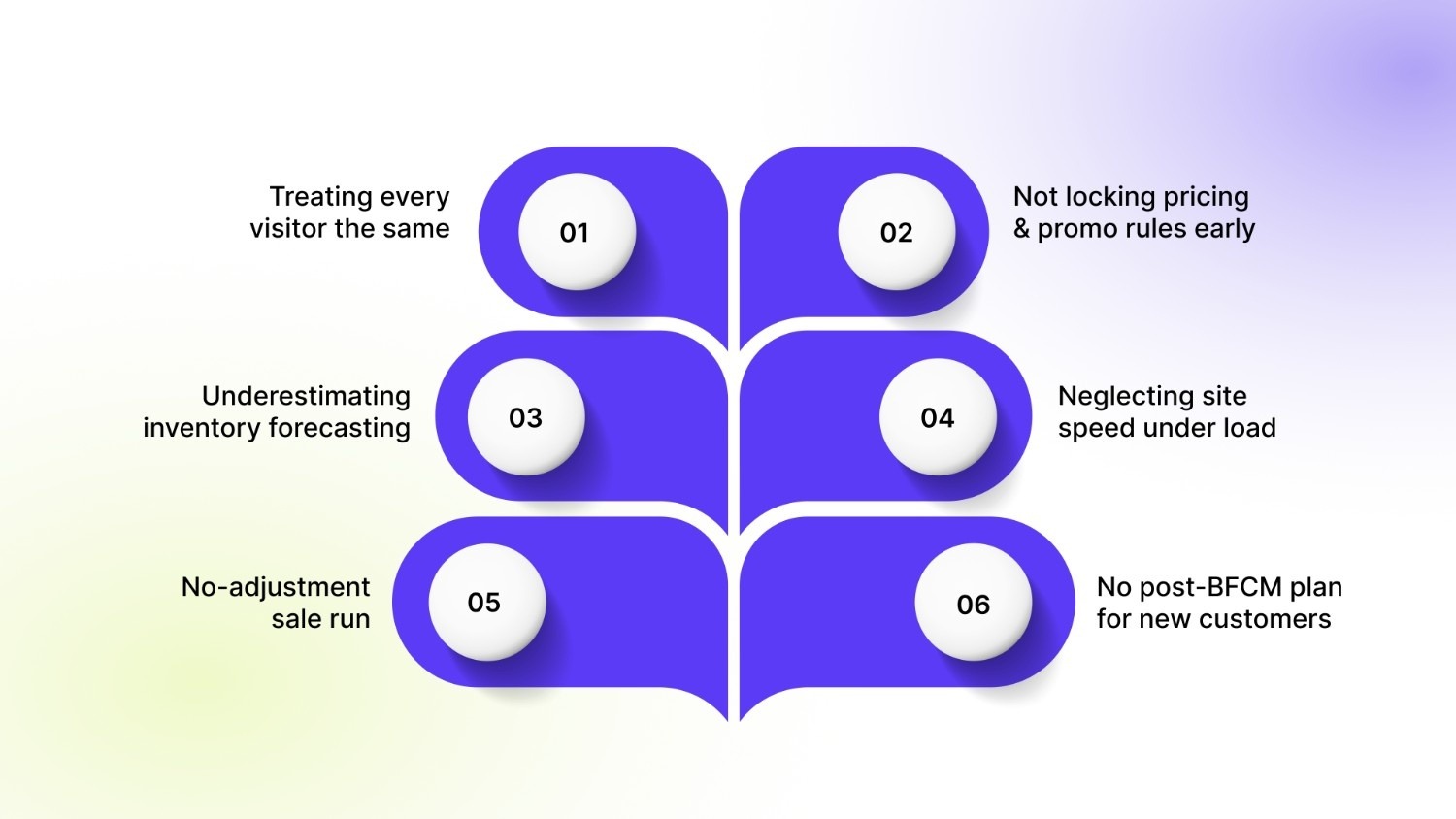
Most revenue leaks during BFCM come from operational decisions rather than marketing. These are the mistakes that quietly destroy conversion rates and profitability.
Mistake 1: Treating every visitor the same
Sending cold traffic, warm subscribers, and VIP customers to the same offer reduces conversion and AOV.
- Fix: Create segmented offers. VIP rewards should be different from first-purchase incentives. Paid traffic should land on offer-matched pages.
Mistake 2: Not locking pricing and promo rules early
Last-minute price edits break bundles, discount stacks, free shipping thresholds, and gift logic. When this happens during peak hours, AOV collapses.
- Fix: Freeze all pricing structures 7 to 10 days before BFCM and conflict checks to ensure discounts, bundles, and gifts trigger correctly.
Mistake 3: Underestimating inventory forecasting
Brands run ads for products with only a few days' stock. This inflates CAC because ad spend drives people to items that are unavailable.
- Fix: Allocate inventory to top-selling SKUs before launching campaigns, and route ads to products with strong stock coverage.
Mistake 4: Neglecting site speed under load
A store that loads in 2 seconds during regular traffic suddenly takes 8 seconds during peak traffic. Every extra second increases abandonment, especially on mobile.
- Fix: Stress test theme, apps, and media files before BFCM. Defer non-essential scripts and reduce high-resolution assets during the sale.
Mistake 5: Running a static sale without mid-campaign adjustments
Some brands launch on Friday and keep the same offer until Monday, even if specific SKUs are failing or traffic segments are underperforming.
- Fix: Monitor real-time analytics for underperforming bundles, declining conversion rates, or channel-specific drop-offs and adjust offers immediately.
Mistake 6: No post-BFCM plan for new customers
Brands spend aggressively to acquire buyers but do nothing to convert them a second time, so lifetime value crashes after December.
- Fix: Pre-build second-purchase flows and trigger them automatically after delivery with targeted product recommendations and exclusive loyalty benefits.
Avoiding these common mistakes will keep your sales on track and help turn BFCM shoppers into long-term repeat customers.
Maximize BFCM Revenue with StarApps Studio Tools
BFCM demands speed and clarity. Shoppers make purchase decisions in seconds, not minutes, and any friction on product pages, unclear variants, missing images, or confusing options results in abandoned carts. StarApps Studio gives Shopify merchants the control needed to display products and variants in a clean, intuitive way that keeps customers moving toward checkout.
Below are StarApps applications that directly solve the product discovery and selection challenges most stores experience during BFCM.
Color Swatch King
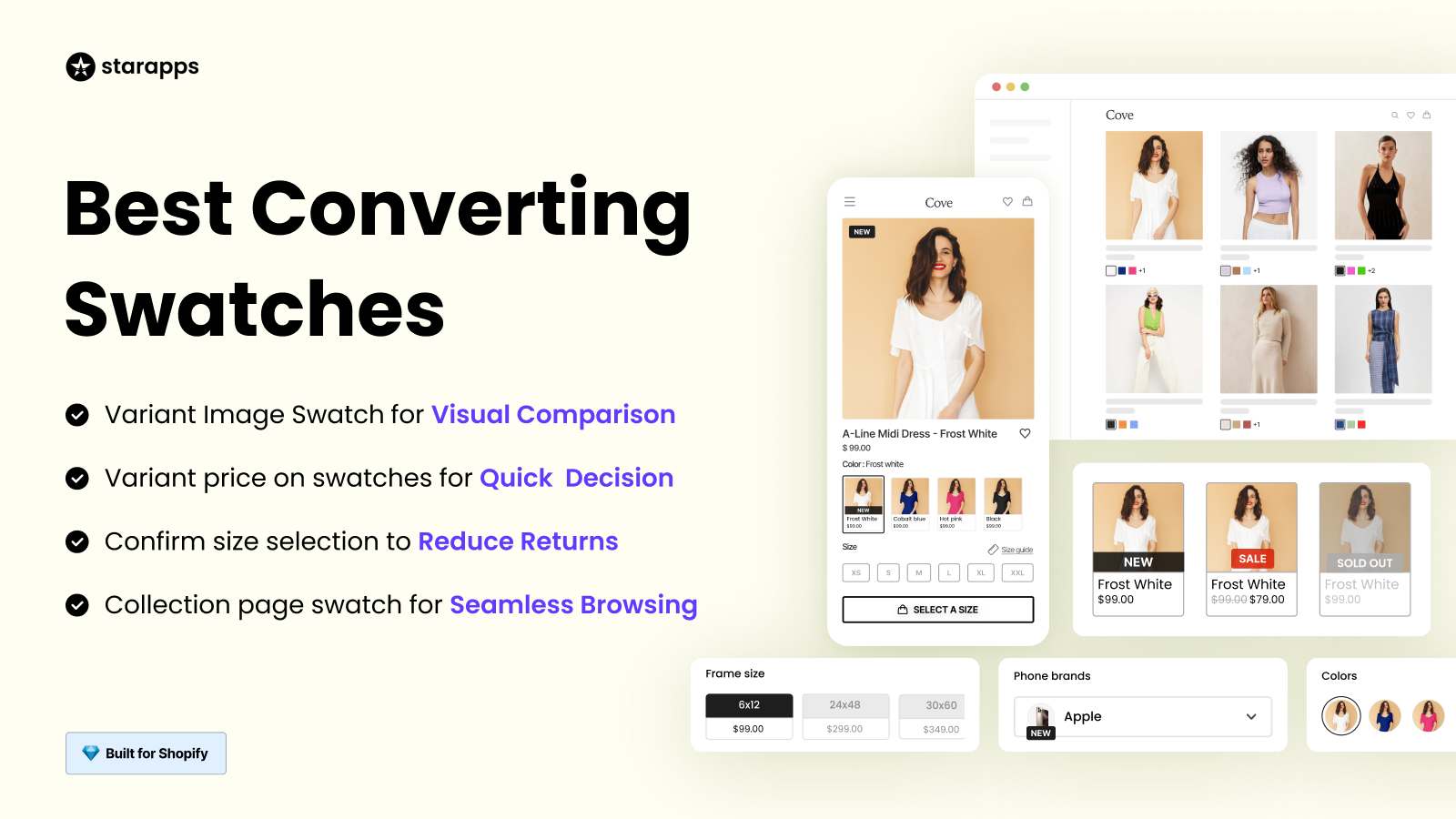
BFCM traffic often lands on collection pages first, and if variant options aren’t visible there, shoppers bounce. Color Swatch King makes variant selection instant and visual across the store.
How it boosts conversions during BFCM:
- Displays color and pattern swatches on collection pages so shoppers don’t need to click through each product.
- Supports custom swatch types, including images and thumbnails, for accurate representation of prints and textures.
- Automatically hides out-of-stock variants to prevent shoppers from selecting unavailable options.
- Bulk swatch uploads via CSV ensure extensive catalogs can be optimized quickly ahead of BFCM.
- Fully compatible with Shopify Markets, filters, and search.
Variant Image Automator
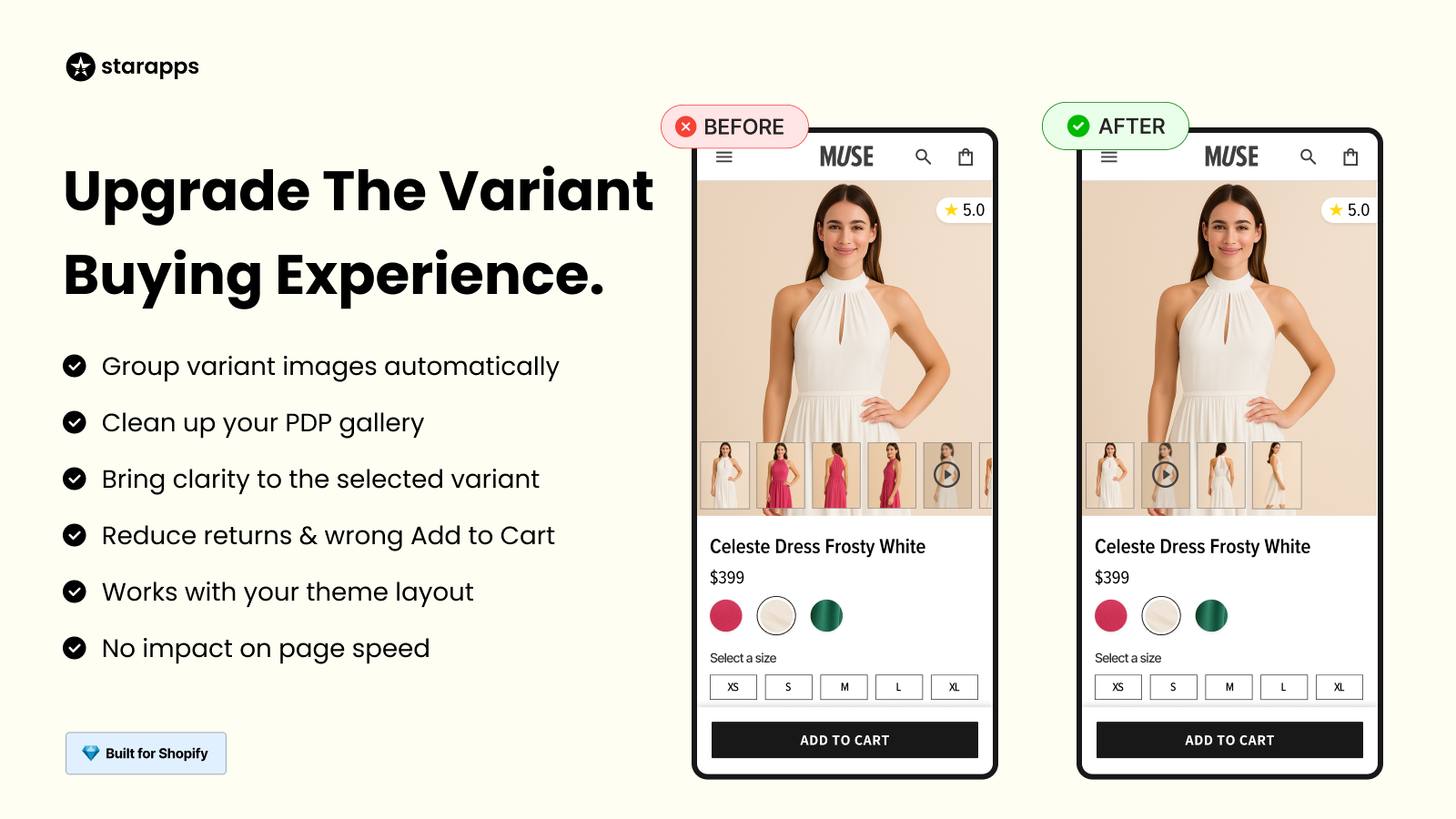
During BFCM, shoppers won’t manually click image thumbnails trying to match colors to photos. Variant Image Automator ensures the right visuals appear without effort.
How it improves the product experience:
- Auto-assigns correct images to each variant based on naming or upload logic, eliminating manual mapping.
- Shows only relevant images for the selected variant, reducing clutter and confusion.
- Supports videos and 3D models across variants without requiring a separate setup.
- Retains your existing gallery layout and theme styling, keeping branding intact during automation.
Variant Descriptions King
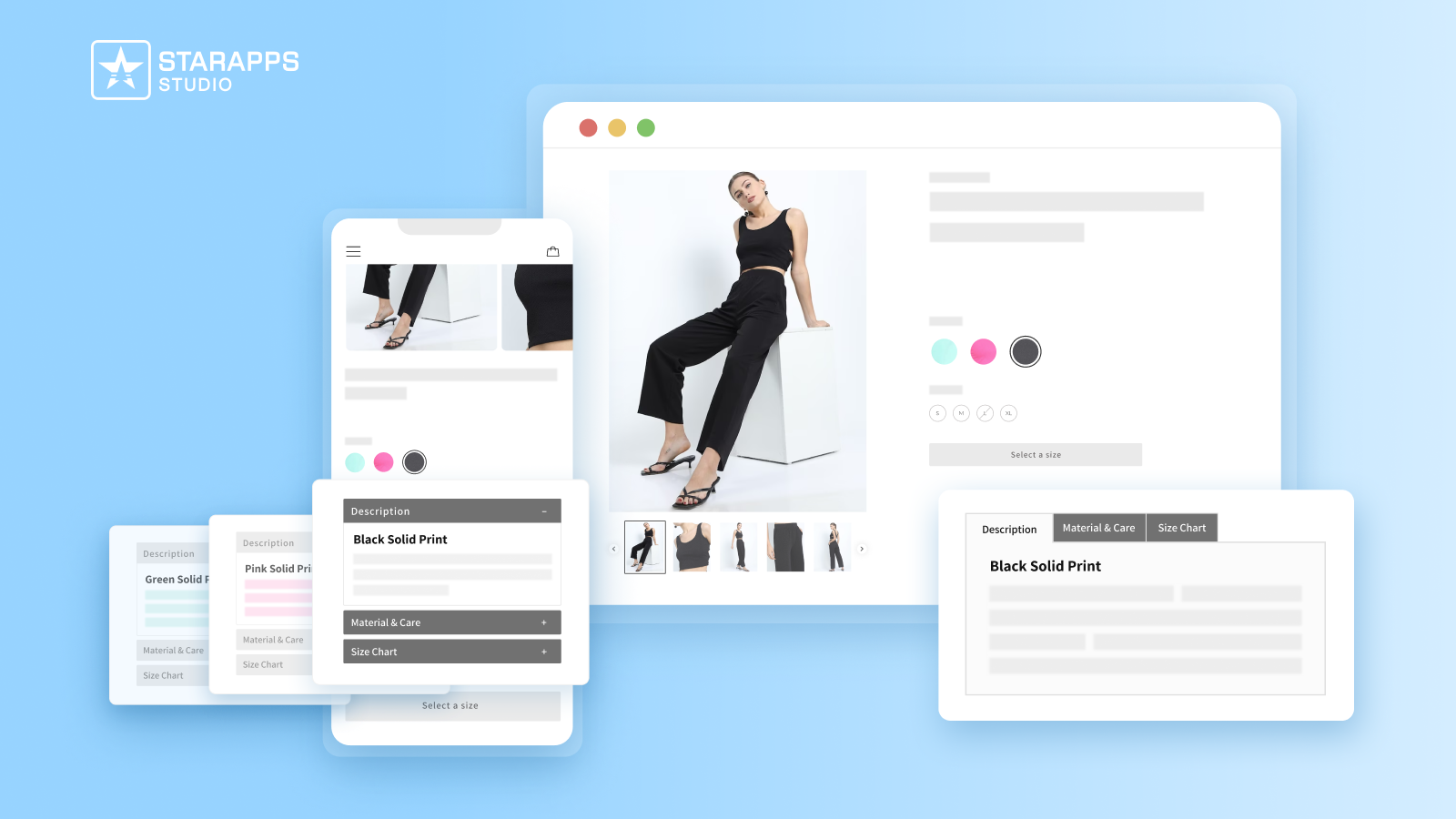
Shoppers hesitate when variant details aren’t precise. Variant Descriptions King delivers the exact information customers need without overwhelming the page layout.
How it strengthens product clarity:
- Displays details for each variant in clean tabs or accordions to reduce scrolling.
- Highlight material, fit, specifications, or size differences that matter for purchase confidence.
- Works across product and collection landing pages for consistent messaging.
- Requires no custom coding, allowing merchants to launch improvements quickly before the sale period.
SA Variants Combined Listings
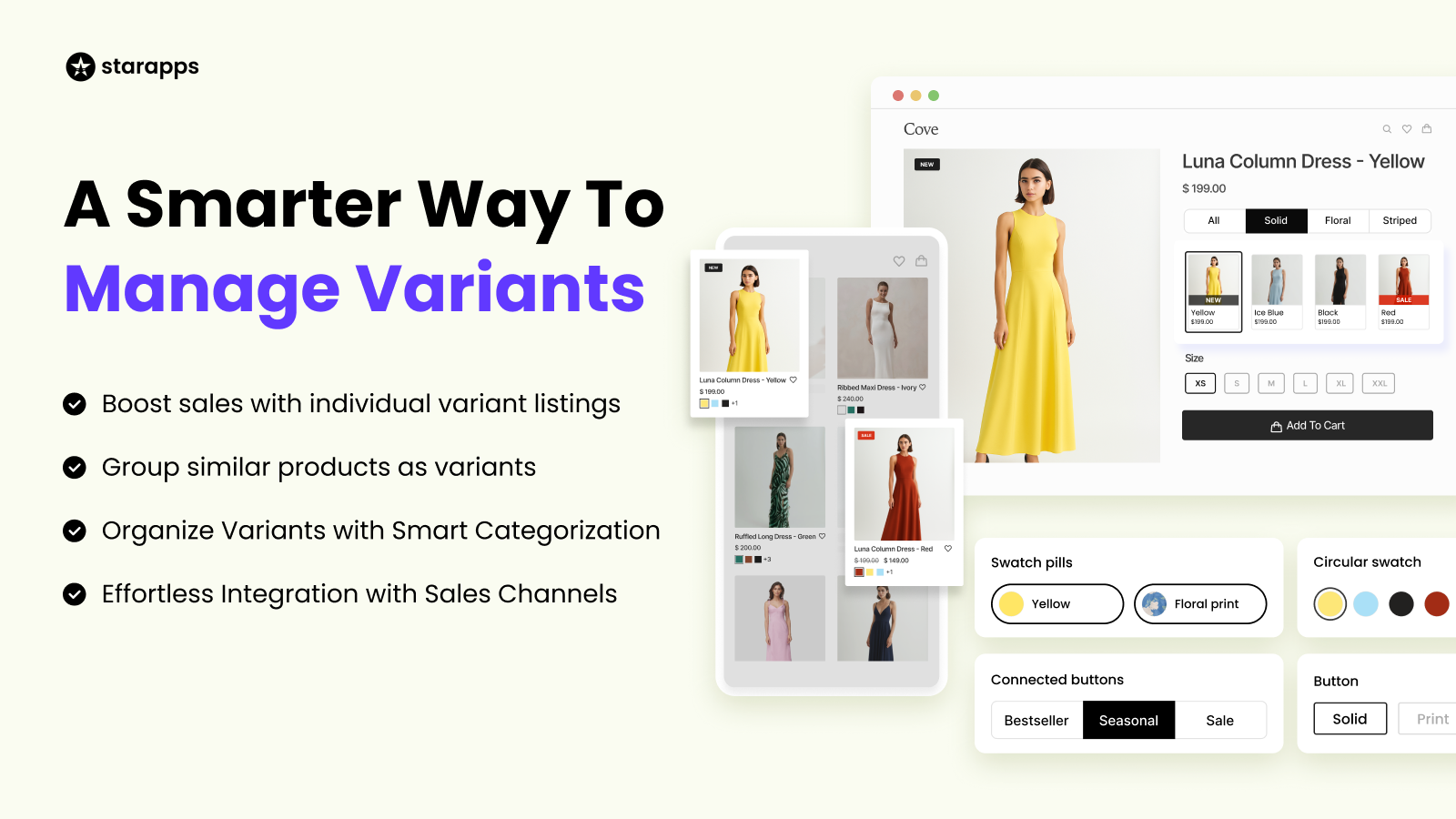
During BFCM, visibility is everything. SA Variants Combined Listings help every color or style get discovered instead of hiding under a single parent product.
How it increases product visibility:
- Creates individual collection-page listings for each variant to improve exposure.
- Generates SEO-friendly URLs for each product variation, improving search performance.
- Treats each variant as filterable on collection pages, giving shoppers faster ways to find what they want.
- Works smoothly with Color Swatch King for swatch-first navigation on these listings.
With StarApps Studio, every product and variant is displayed clearly and efficiently, reducing friction and keeping shoppers moving toward checkout, turning clicks into revenue during BFCM.
Conclusion
BFCM 2026 will reward the brands that plan, remove friction, and create a clear path from browsing to purchase. Every touchpoint, from product pages to checkout, matters when shoppers decide in seconds.
The steps outlined in this guide cover strategy, personalization, urgency, and post-sale momentum, but even the best plans can lose impact if product presentation slows buyers down. That’s where StarApps Studio comes in. Its tools make variants, images, and descriptions instantly clear, ensuring customers can find what they want and check out without hesitation.
Set your store up to capture more sales and turn BFCM traffic into lasting revenue. Get in touch with StarApps Studio and see how they can streamline your product experience before the 2026 weekend hits.
FAQ’s
1. What tactic do luxury brands often use during Black Friday to attract shoppers?
Luxury brands often offer limited-time exclusive products, VIP early access, or curated bundles. They focus on creating a premium, personalized experience rather than deep discounts to maintain brand value.
2. How do you attract customers on Black Friday?
Attract customers by promoting limited-time deals, highlighting best sellers, leveraging email and SMS campaigns, creating urgency, and using social proof to show active demand and build trust.
3. What are four ways to attract customers?
Offer exclusive deals, create personalized recommendations, use clear product messaging, and implement urgency tactics. These strategies encourage engagement, increase conversion rates, and prompt shoppers to act faster.
4. What do people buy the most on Black Friday?
Electronics, appliances, clothing, and beauty products lead Black Friday purchases. Consumers focus on high-value or seasonal items, often targeting gifts and items with substantial perceived savings.
5. How to advertise on Black Friday?
Advertise by combining email marketing, paid social ads, search campaigns, and retargeting strategies. Highlight exclusive deals, urgency, and product value to capture attention and drive traffic during the high-competition period.
Heading

End-to-end traceability
To ensure regulatory compliance, you must have a complete overview of your products from production to shipping. Book a demo to see how Katana can give you full visibility of your operations.
.png)

.svg)

.svg)

.svg)
.png)