

Boost efficiency with AI for inventory management automation. Discover dynamic replenishment, real-time insights, and omnichannel optimization. Click for smarter forecasting!
Inventory management is challenging because too much stock ties up cash, while too little results in missed sales and customer frustration.
As catalogs grow and demand becomes less predictable, managing inventory manually becomes risky and inefficient.
This is where AI for inventory management automation is changing how businesses operate.
Instead of relying on spreadsheets or static forecasts, AI helps brands react to real-time demand, sales trends, and supply chain signals. It turns inventory decisions into data-backed actions rather than guesswork.
AI-powered inventory systems can reduce stock-outs by up to 40%, improving inventory reliability and reducing lost sales in modern supply chains.
For Shopify merchants and product-heavy brands, this shift matters more than ever. Inventory mistakes scale quickly as traffic, SKUs, and sales channels grow.
In this article, we’ll break down how AI for inventory management automation works, where it delivers the most value, and how businesses can use it to improve efficiency, accuracy, and growth.
Key Takeaways
- AI drives smarter inventory: Automates demand forecasting, stock allocation, and safety stock adjustments.
- Real-time visibility matters: Keeps inventory consistent across Shopify, marketplaces, and fulfillment apps.
- High-SKU stores benefit most: AI prioritizes fast-moving products and reduces slow-moving stock.
- Automation reduces errors: Routine tasks like reorders and inventory updates happen automatically.
- StarApps enhances performance: Ensures fast, scalable Shopify storefronts so AI workflows work in real time.
How AI Enables Inventory Management Automation
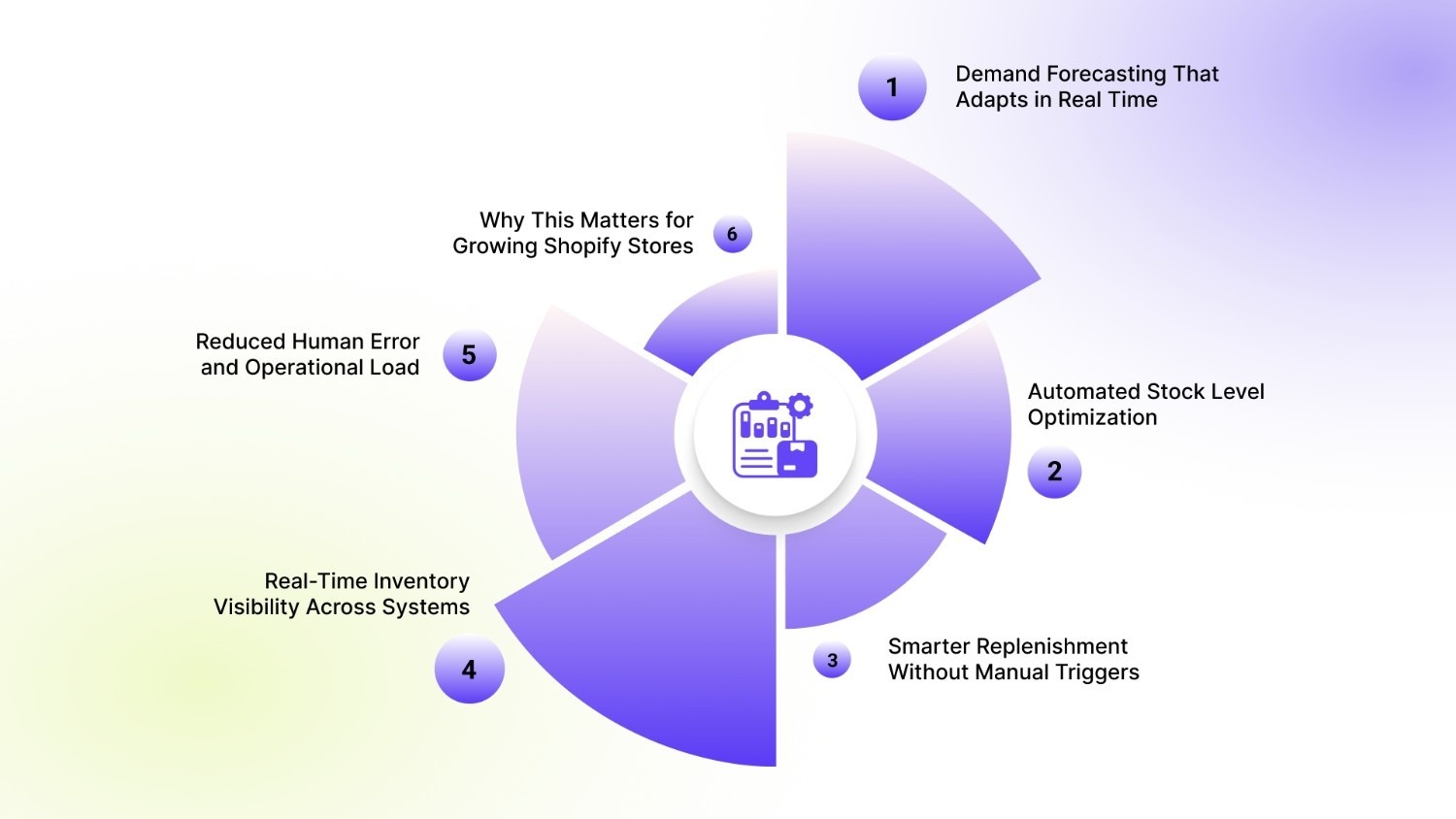
At its core, AI for inventory management automates manual decision-making through continuous analysis.
Instead of checking stock levels occasionally or reacting after problems occur, AI systems monitor inventory constantly and act before issues escalate.
AI automation typically works across four key areas:
- Forecasting demand to predict needs
- Stock control to maintain optimal inventory levels
- Replenishment to automate ordering processes, and
- Visibility to provide real-time inventory tracking across channels
Each area removes friction from day-to-day operations while improving accuracy over time.
Demand Forecasting That Adapts in Real Time
Traditional forecasting relies heavily on historical data.
AI goes further by combining past sales with real-time signals such as promotions, seasonality, and sudden demand shifts.
AI models continuously learn from:
- Recent sales velocity
- Product-level trends
- Seasonal patterns
- Campaign-driven spikes
This allows businesses to adjust forecasts dynamically rather than locking in plans months in advance.
For fast-moving Shopify stores or brands with frequent launches, this adaptability prevents both over-ordering and stock shortages.
Automated Stock Level Optimization
Once demand is predicted, AI systems automatically determine how much inventory to hold.
This includes calculating safety stock, which refers to the extra inventory kept on hand to prevent stockouts caused by demand variability or supply delays, reorder points, and optimal stock levels for each SKU.
Instead of treating all products the same, AI prioritizes inventory based on:
- Product performance
- Sales consistency
- Profitability
- Lead times
This means high-performing products stay available, while slow-moving inventory doesn’t quietly drain cash.
Smarter Replenishment Without Manual Triggers
Manual reordering is one of the most time-consuming inventory tasks.
AI automation removes this bottleneck by triggering replenishment actions automatically when conditions are met.
AI-powered systems can:
- Generate reorder alerts
- Recommend order quantities
- Adjust timing based on supplier delays or demand changes
This reduces last-minute decisions and helps teams plan inventory with confidence rather than urgency.
Real-Time Inventory Visibility Across Systems
As businesses expand across sales channels, maintaining inventory visibility becomes harder.
AI-powered inventory automation keeps stock data synced in real time across platforms.
For Shopify merchants, this means:
- Accurate stock levels across storefronts and apps
- Fewer overselling issues
- More reliable delivery promises to customers
Real-time visibility also supports better internal planning, allowing teams to align marketing, fulfillment, and purchasing decisions.
Reduced Human Error and Operational Load
Inventory errors often come from repetitive manual work.
AI reduces this by automating routine updates and flagging anomalies that need attention.
Automation helps by:
- Eliminating manual stock adjustments
- Reducing spreadsheet dependency
- Highlighting unusual inventory behavior
This doesn’t replace human oversight.
Instead, it allows teams to focus on strategy, supplier relationships, and growth planning.
Why This Matters for Growing Shopify Stores
Shopify stores often reach a point where inventory complexity outpaces internal processes.
AI-driven automation supports growth by scaling effortlessly with catalogs, variants, and traffic.
When paired with performance-focused tools like StarApps, a Shopify app designed to optimize product page loading speeds and handle variant complexity, ensuring AI-driven inventory decisions are supported by fast, reliable storefront performance.
It ensures fast-loading product and variant experiences, and AI for inventory management automation becomes more effective.
Backend intelligence only delivers value when storefront performance keeps up.
At the core of inventory automation is one critical capability: accurately predicting what customers will buy and when.
How AI Forecasts Demand More Accurately
Accurate demand forecasting is the foundation of strong inventory management.
When forecasts are off, businesses either overstock and block cash or understock and lose sales.
This is where AI for inventory management automation delivers its biggest impact.
AI models analyze far more data points than traditional forecasting methods. Instead of relying mainly on last year’s sales, AI continuously processes multiple inputs to identify demand patterns as they form.
These systems learn and improve over time, making forecasts more reliable with every sales cycle.
AI-powered demand forecasting typically considers:
- Seasonal and historical sales trends
- Promotions, discounts, and marketing campaigns
- Regional and channel-specific buying behavior
- External signals like holidays, weather shifts, or demand spikes
Because forecasts update dynamically, businesses can make smarter purchasing and production decisions.
This allows teams to stock the right products at the right time without tying up excess capital in slow-moving inventory.
A real-world example is Zara, which uses advanced data analytics and automation to respond quickly to changing fashion demand.
By closely tracking sales data and customer behavior, the brand adjusts production and inventory levels faster than traditional retailers, reducing overstock and improving sell-through.
For Shopify merchants, this level of forecasting accuracy is especially valuable during flash sales, seasonal promotions, or product launches, moments when demand can change rapidly and manual planning often falls short.
Forecasting demand is one piece of the puzzle, knowing exactly where your inventory stands is the next.
Real-Time Inventory Visibility Across Channels
As your store grows, keeping inventory data consistent across all sales channels becomes a real challenge.
Selling on Shopify, marketplaces like Amazon or eBay, and even in-store, can lead to mismatched stock numbers when updates happen slowly.
These mismatches often result in canceled orders, stockouts, or overselling, frustrating your customers and hurting your brand reputation.
AI-powered inventory systems solve this by keeping everything in sync in real time. That means every sale, return, restock, or transfer updates your inventory instantly across all platforms.
With accurate stock data flowing seamlessly, your team gets a precise and reliable picture of inventory at every moment.
Why real-time visibility matters:
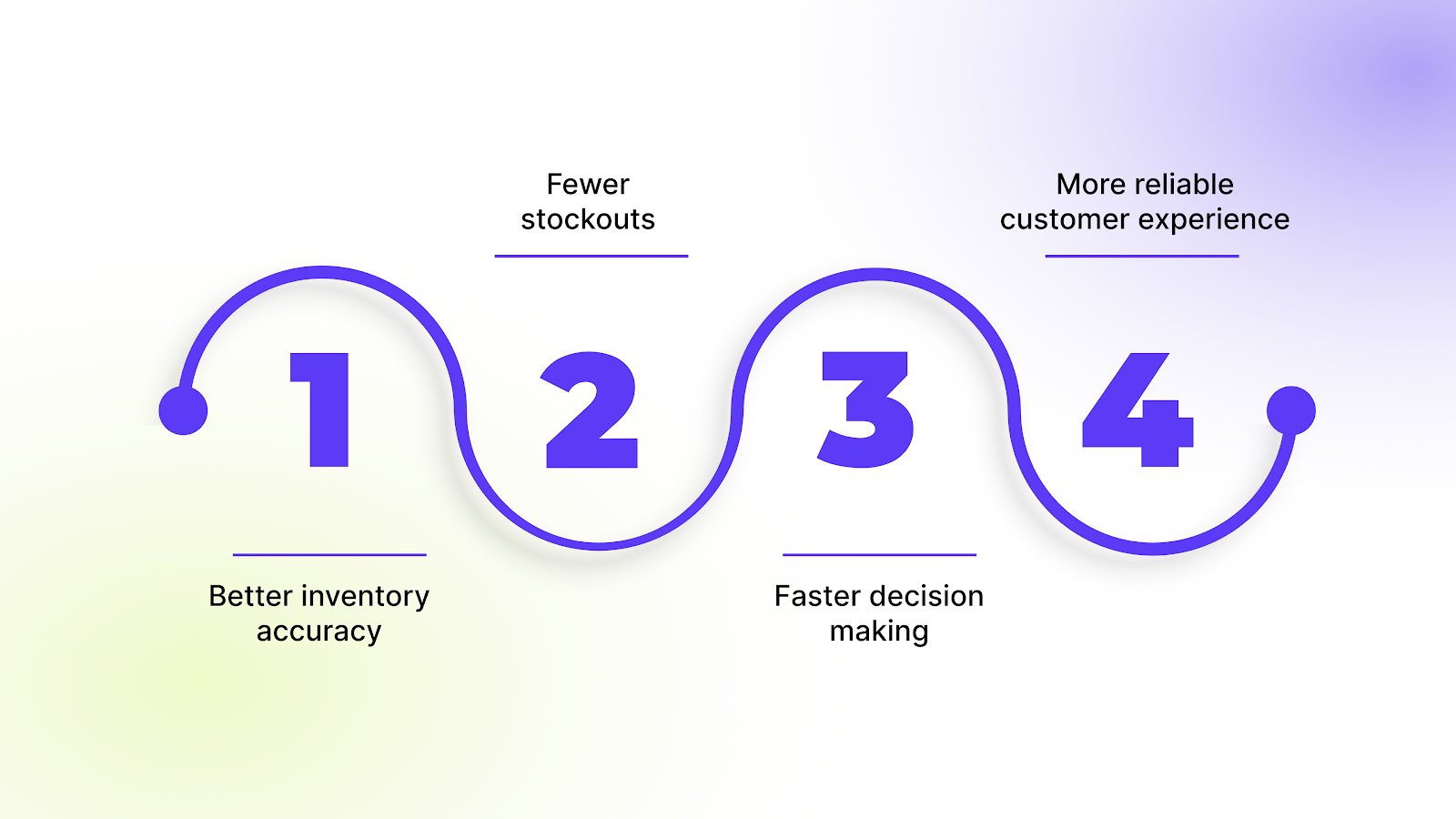
- Better inventory accuracy: Real-time systems can improve stock data accuracy dramatically, often boosting accuracy by up to 35% compared to delayed updates.
- Fewer stockouts: Fewer mismatches between systems means fewer missed sales opportunities.
- Faster decision making: Teams can act quickly when stock levels change, no waiting for stale reports.
- More reliable customer experience: Accurate availability builds trust and reduces cancellations.
With real-time visibility, Shopify merchants can confidently plan replenishment, balance inventory across warehouses or sales channels, and avoid last-minute emergencies.
In today’s omnichannel world, this level of transparency isn’t just helpful, it’s essential for scaling without chaos.
With inventory visibility in place, the next opportunity is reducing the manual work required to manage it.
Automation That Reduces Manual Work and Errors
For Shopify merchants, inventory work often happens across multiple tools.
Stock updates come from the storefront, apps, warehouses, and fulfillment partners. Managing all of this manually quickly becomes overwhelming and increases the risk of mistakes.
AI-powered automation fits naturally into Shopify operations by connecting inventory data across apps and sales channels.
Instead of logging into multiple systems or updating spreadsheets, AI tools monitor inventory activity in real time and take action automatically.
For Shopify stores, AI automation helps by:
- Triggering reorder alerts based on Shopify sales velocity and product performance
- Adjusting safety stock levels as demand changes during sales, launches, or seasonal peaks
- Flagging unusual inventory changes caused by app conflicts, sync issues, or fulfillment errors
This reduces day-to-day manual work and helps prevent costly overselling or stockouts.
More importantly, it gives Shopify teams confidence that inventory data is accurate, even as catalogs and traffic grow.
When combined with performance-focused tools like StarApps, which keep product and variant experiences fast and reliable, AI-driven automation works smoothly without slowing down the storefront.
That balance between automation and performance is what allows Shopify stores to scale without operational headaches.
Once manual work is reduced, inventory planning becomes far more strategic.
Smarter Inventory Planning for High-SKU Businesses
Each new SKU adds decisions around how much to stock, which products to prioritize, and when to reorder.
For brands with hundreds or thousands of items, treating every product the same often leads to excess inventory in some areas and shortages in others.
AI for inventory management automation brings structure to this complexity.
Instead of applying a single rule across the entire catalog, AI evaluates products individually.
It looks at sales velocity, changing demand patterns, and product performance, then adjusts inventory plans based on real data.
This smarter approach helps businesses:
- Prioritize high‑performing products that drive most of the revenue
- Spot slow‑moving or dead stock early before it ties up working capital
- Allocate inventory budgets more effectively across categories and locations
A strong Shopify example here is Brooklinen, a direct‑to‑consumer home essentials brand with a broad and variant‑heavy catalog (sheets, towels, pillows, accessories).
With frequent seasonal demand and a wide range of products, Brooklinen benefits from data‑driven inventory planning that keeps popular lines in stock while avoiding excess on slower variants.
AI helps brands like this balance customer expectations with smart inventory allocation, without relying on manual guesswork.
For beauty, electronics, home goods, and other high‑SKU brands, AI‑driven inventory planning turns from a challenge into a competitive advantage.
With smarter planning in place, it’s easier to see how Shopify merchants can put these insights into action.
How Shopify Merchants Benefit Specifically
Shopify stores often grow faster than their internal systems can handle.
As traffic, SKUs, and sales channels increase, inventory challenges appear quickly- overselling, stockouts, and slow replenishment can start impacting revenue and customer trust.
AI-driven inventory management integrates seamlessly with Shopify, helping merchants stay ahead of these challenges.
By connecting directly with your Shopify store and apps, AI tools make inventory smarter, faster, and more reliable.
Key benefits for Shopify merchants include:
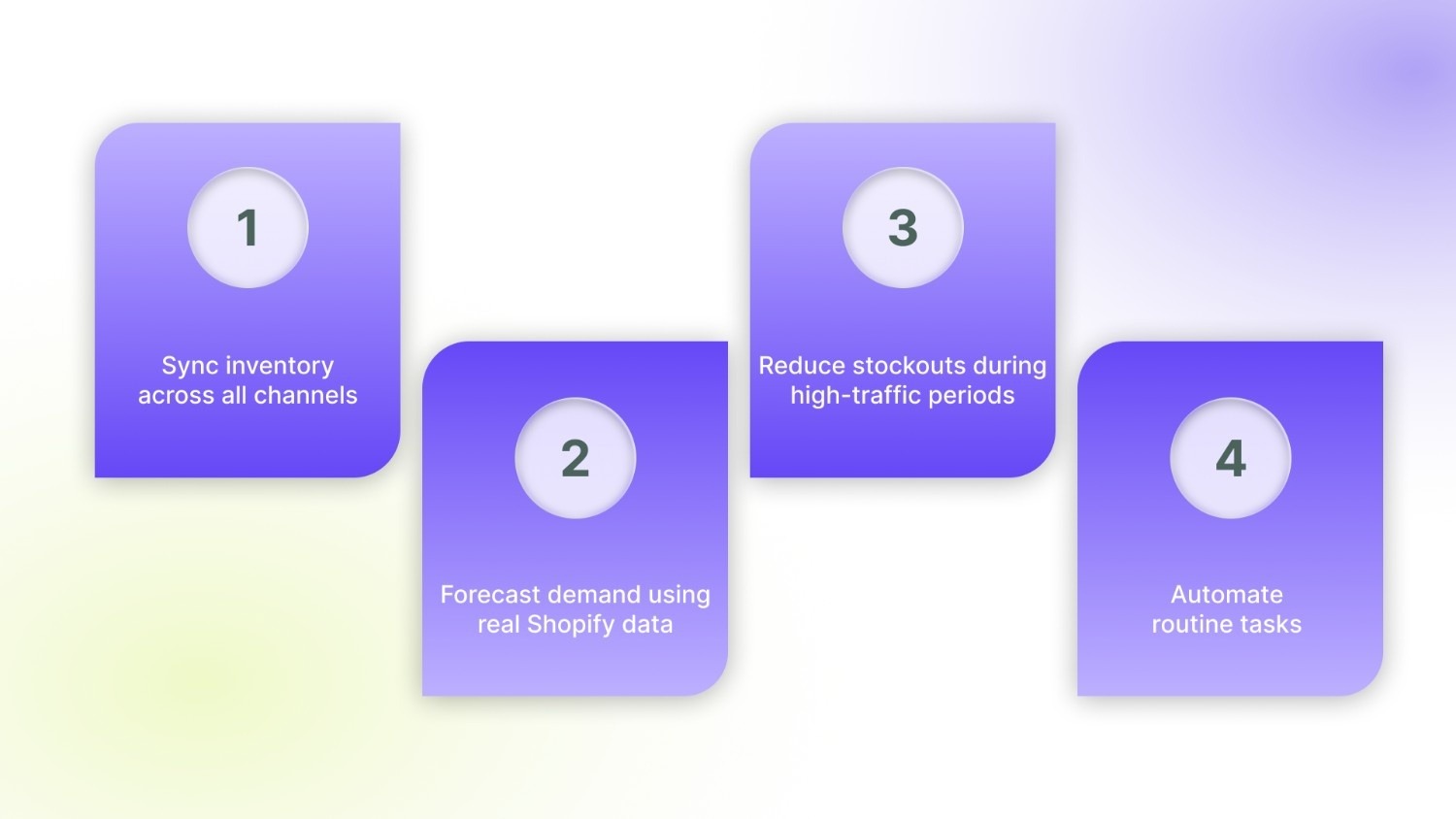
- Sync inventory across all channels: Keep stock levels consistent between Shopify, marketplaces, and fulfillment apps, reducing overselling and errors.
- Forecast demand using real Shopify data: Predict sales trends based on actual store performance, seasonal spikes, and promotions.
- Reduce stockouts during high-traffic periods: Ensure popular products are available during sales events, launches, or seasonal peaks.
- Automate routine tasks: Trigger reorders, adjust safety stock, and flag unusual activity without manual effort.
Inventory updates need to happen quickly without slowing the storefront or causing customer delays.
For Shopify merchants, combining AI inventory automation with a performance-focused layer creates a system that’s not just smart but also scalable, reliable, and ready for growth.
That’s where tools like StarApps shine.
By keeping product and variant experiences fast and reliable, StarApps complements AI workflows and ensures that automation actually works in real time, even for high-traffic stores with complex catalogs.
StarApps: Supercharge Your Shopify Store Performance

Running a Shopify store is about delivering fast, seamless shopping experiences while keeping operations under control.
This is where StarApps comes in.
Designed specifically for Shopify merchants, StarApps enhances storefront performance while complementing AI-driven workflows behind the scenes.
Why StarApps Matters
Even the most intelligent AI can’t perform at its best if your store slows down under heavy traffic or an extensive catalog.
StarApps ensures that:
- Product and variant experiences load instantly- fast-loading product pages keep customers engaged and reduce bounce rates.
- High-SKU stores stay manageable- StarApps scales smoothly with thousands of variants, making complex inventories feel simple.
- AI workflows actually work- seamless syncing between the storefront and AI-driven inventory tools ensures your automation delivers real-world results.
Key Benefits for Shopify Merchants
- Faster storefront performance: Quick-loading pages and responsive variants improve customer experience and conversion.
- Simplified inventory complexity: Works alongside AI tools to handle multi-channel stock and variant-heavy catalogs.
- Scalable for growth: Whether you’re running a flash sale, launching new products, or managing a high-traffic event, StarApps keeps your store running smoothly.
- Seamless integration: No complicated setup, StarApps works natively within Shopify, so merchants can focus on selling, not troubleshooting apps.
Why It Adds Value
When paired with AI inventory automation, StarApps acts like the “performance engine” for your Shopify store.
AI can forecast demand, manage stock, and automate tasks but StarApps ensures that every product page and variant stays fast and reliable, even as complexity grows.
For high-traffic stores, this combination reduces errors, improves customer trust, and maximizes sales opportunities.
Ready to keep your Shopify store fast, scalable, and automation-ready?
Try StarApps today and supercharge your product and variant performance with zero setup hassle.
Final Thoughts
Inventory no longer needs to be a constant source of stress.
With AI for inventory management automation, businesses can move from reactive firefighting to proactive planning.
Start by identifying where manual work slows you down. Look for AI tools that integrate with your existing systems and scale as your catalog grows.
Pair automation with performance-focused Shopify tools to ensure your storefront keeps up with backend intelligence.
Boost your Shopify store’s speed and reliability, experience StarApps and let your AI automation work seamlessly.
When inventory works smarter, growth becomes easier to manage.
FAQs
What is AI for inventory management automation?
It uses artificial intelligence to forecast demand, automate stock updates, and optimize inventory decisions with minimal manual input.
Is AI inventory management suitable for small Shopify stores?
Yes. Many tools scale from small catalogs to large ones, helping stores prepare for growth early.
How does AI reduce stockouts?
AI predicts demand more accurately and triggers timely reorders, reducing the risk of running out of stock.
Can AI handle multiple warehouses or locations?
Most advanced AI systems support multi-location inventory tracking and optimization.
Does AI replace inventory managers?
No. AI supports decision-making by providing better insights, while humans handle strategy and exceptions.
Heading

End-to-end traceability
To ensure regulatory compliance, you must have a complete overview of your products from production to shipping. Book a demo to see how Katana can give you full visibility of your operations.

.png)

.svg)

.svg)

.svg)
.png)