


Learn strategies for effective variant management in manufacturing. Optimize inventory, reduce errors, and improve Shopify storefronts with StarApps.
Modern manufacturing teams are managing more product variations than ever before. Sizes, materials, finishes, regions, and custom configurations quickly turn a single product into dozens of variants.
As this complexity grows, even small mistakes in planning or visibility can create serious operational issues.
Shopify notes that retailers lose $1.1 trillion globally each year due to overstocking and stockouts, often caused by poor inventory planning and a lack of real-time product visibility
This is where variant management becomes critical. When product variations aren’t properly structured and controlled, inventory decisions break down, production slows, and customers see inaccurate availability.
Strong variant management helps manufacturers keep operations aligned as catalogs expand.
In this article, we’ll explore practical strategies for effective variant management in manufacturing, focusing on reducing complexity, improving inventory accuracy, and supporting scalable growth without losing control.
Key Takeaways
- Variant management is a core operational strategy, not just SKU tracking
- Clear structure and naming prevent chaos as catalogs grow
- Planning must happen at the variant level to stay accurate
- Automation works best after the structure is fixed
- Shopify brands need both backend discipline and frontend performance
- StarApps helps variant-heavy stores stay fast and reliable
What Variant Management Really Means (and Why It Breaks at Scale)
Variant management is often misunderstood as basic SKU tracking.
In reality, it’s the system that governs how every product option is created, connected, maintained, and sold across the business.
It defines the relationship between a base product and its variations and ensures that those relationships remain consistent wherever they appear.
When variant management is done well, teams can add new options without disrupting operations. When it’s done poorly, complexity grows faster than the business can handle.
Why does variant complexity increase faster than expected
Most manufacturers start simple.
A product launches with a few variations.
Over time, more options are added to meet market demand, regional requirements, or customization requests.
Each addition feels manageable on its own.
The problem is that variants don’t grow linearly. They grow exponentially.
A few extra attributes like size, color, and material can quickly multiply into dozens or hundreds of combinations.
Without a clear structure, every new variant increases the risk of errors across planning, production, inventory, and sales.
Where variant management usually breaks down
The first signs of trouble are often subtle:
- Every variant is treated like a separate product, leading to duplicated data and inconsistent updates
- Naming conventions drift between tools or teams, making reporting unreliable
- Sales channels show combinations that production can’t support, creating backorders and cancellations
- Inventory decisions are made without variant-level insight, causing overstock in some options and shortages in others
Over time, teams rely on spreadsheets and manual checks to fill the gaps.
What starts as a workaround slowly becomes the system.
The real cost of weak variant management
Poor variant management doesn’t just create internal frustration; it directly impacts business outcomes.
- Planning becomes reactive instead of strategic
- Inventory carrying costs increase due to slow-moving variants
- High-demand combinations run out first
- Customer trust drops when availability is inaccurate
These issues compound as the catalog grows, making it harder to scale without adding more overhead.
What strong variant management does differently
Effective variant management creates structure before complexity takes over. It ensures that product variations are connected logically, governed by rules, and consistently represented across systems.
Instead of asking, “How do we manage all these SKUs?” strong teams ask, “How do these variants relate to each other?”
That shift in thinking makes everything else forecasting, automation, inventory planning, and storefront accuracy far easier to manage.
Structure is the foundation but it has to be designed intentionally before scale exposes its cracks.
H2 -
Strategy 1: Build Variant Structure Before You Scale Production

Most variant problems don’t start at scale. They start early, when product options are added quickly without clear rules. What feels flexible in the beginning often becomes difficult to manage later.
The way variants are defined upfront decides how easy or painful growth will be.
Define clear variant attributes
Every product should be built from a small, consistent set of attributes.
These attributes serve as the foundation for all subsequent variants.
Common examples include:
- Size
- Color or finish
- Material
- Region or compliance type
- Optional features or add-ons
Keeping these attributes limited and clearly defined makes a big difference.
Free-text fields or inconsistent values may save time initially, but they create confusion across systems.
Clean attributes make reporting accurate, forecasting reliable, and updates far easier to manage.
Create parent–child relationships
Instead of managing each variant as a separate product, use a structured relationship:
- One base product acts as the parent
- Variants exist as children tied to shared rules and data
This approach reduces duplication.
When something changes like a description, image, or availability rule, you update it once instead of across dozens of SKUs.
It also lowers the risk of missing small but important updates.
Standardize naming across teams and tools
Variant names should look the same everywhere they appear.
That includes:
- Product and merchandising teams
- Operations and inventory systems
- Sales channels and storefronts
Even small differences, like “Matte Black” versus “Black – Matte,” can break reports and slow decision-making.
Consistent naming keeps teams aligned and prevents small errors from turning into larger problems.
For Shopify-based manufacturers, clean structure and naming also improve how variants are presented on product pages.
Tools like StarApps support this by ensuring variant-heavy catalogs remain easy to browse and fast to load, helping good structure translate into a better storefront experience.
Once structure is in place, planning becomes far more reliable and much easier to scale.
THIS IS THE REWRITTEN STRATEGY SECTION:
Strategy 1: Build Variant Structure Before You Scale Production
Most variant problems don’t start at scale. They begin early, when product options are added quickly without clear rules. What feels flexible at the start often turns into operational friction later. The way variants are defined upfront determines whether scaling stays manageable or becomes chaotic.
Start by creating a clear, consistent foundation that all variants follow:
- Define Clear Variant Attributes: Every product should be built from a small, controlled set of attributes. These attributes act as the foundation for all variants and should remain consistent across systems.
Common examples include:- Size
- Color or finish
- Material
- Region or compliance type
- Optional features or add-ons
- Limiting attributes reduces complexity. Free-text fields or inconsistent values may seem faster initially, but they introduce errors in reporting, forecasting, and inventory tracking. Clean attributes make updates predictable and data reliable.
- Create Parent–Child Relationships: Instead of managing every variant as a standalone product, use a structured hierarchy:
- One base product acts as the parent
- Variants exist as child SKUs tied to shared data and rules
- This reduces duplication. When something changes, such as descriptions, images, or availability, you update it at the parent level once, rather than across multiple SKUs. It also lowers the risk of missing small but critical updates.
- Standardize Naming Across Teams And Tools: Variant names should remain identical wherever they appear, including:
- Product and merchandising systems
- Operations and inventory tools
- Sales channels and storefronts
- Even minor inconsistencies like “Matte Black” versus “Black – Matte” can break reports and slow decision-making. Standardized naming keeps teams aligned and prevents small errors from compounding over time.
For Shopify-based manufacturers, consistent structure and naming also improve how variants appear on product pages. Tools like StarApps Studio help maintain clean, fast-loading variant-heavy catalogs, ensuring operational clarity translates into a smoother storefront experience.
When a variant structure is built early and maintained consistently, scaling production becomes predictable, controllable, and far easier to manage.
Plan Inventory at the Variant Level, Not Just the Product Level
One of the most common mistakes manufacturers make is planning inventory only at the product level.
On paper, it looks clean. In reality, it hides the details that matter most.
Not all variants sell the same way, and treating them equally almost always leads to imbalance.
A product might perform well overall, while certain sizes, colors, or configurations quietly underperform or sell out far faster than expected.
This gap is where inventory problems begin.
Why variant-level planning matters
Demand doesn’t spread evenly across variants. In practice:
- Some sizes or colors consistently outsell others
- Seasonal demand often applies to specific variants, not the entire product
- Regional preferences shift the variant mix in different markets
When these differences are ignored, businesses end up overstocking slow-moving variants and running out of the ones customers actually want.
Shopify notes that 43% of shoppers go to a competitor when an item they want is out of stock, highlighting how costly poor inventory planning can be
Variant-level planning helps reduce this risk by aligning inventory decisions with real buying behavior.
Smarter planning starts with grouping
Managing hundreds of individual SKUs can feel overwhelming, but the goal isn’t to forecast each one in isolation.
Smart teams simplify planning by grouping variants with similar demand patterns.
Instead of forecasting SKU by SKU:
- Group variants that behave similarly
- Track performance at the attribute level, such as size or color
- Adjust production and replenishment based on those patterns
This keeps planning realistic and manageable, while still being far more accurate than product-level forecasts alone.
When manufacturers plan this way, inventory feels controlled instead of reactive.
Good planning only works if data stays accurate everywhere it’s used.
Keep Variant Data Consistent and Automate What Matters
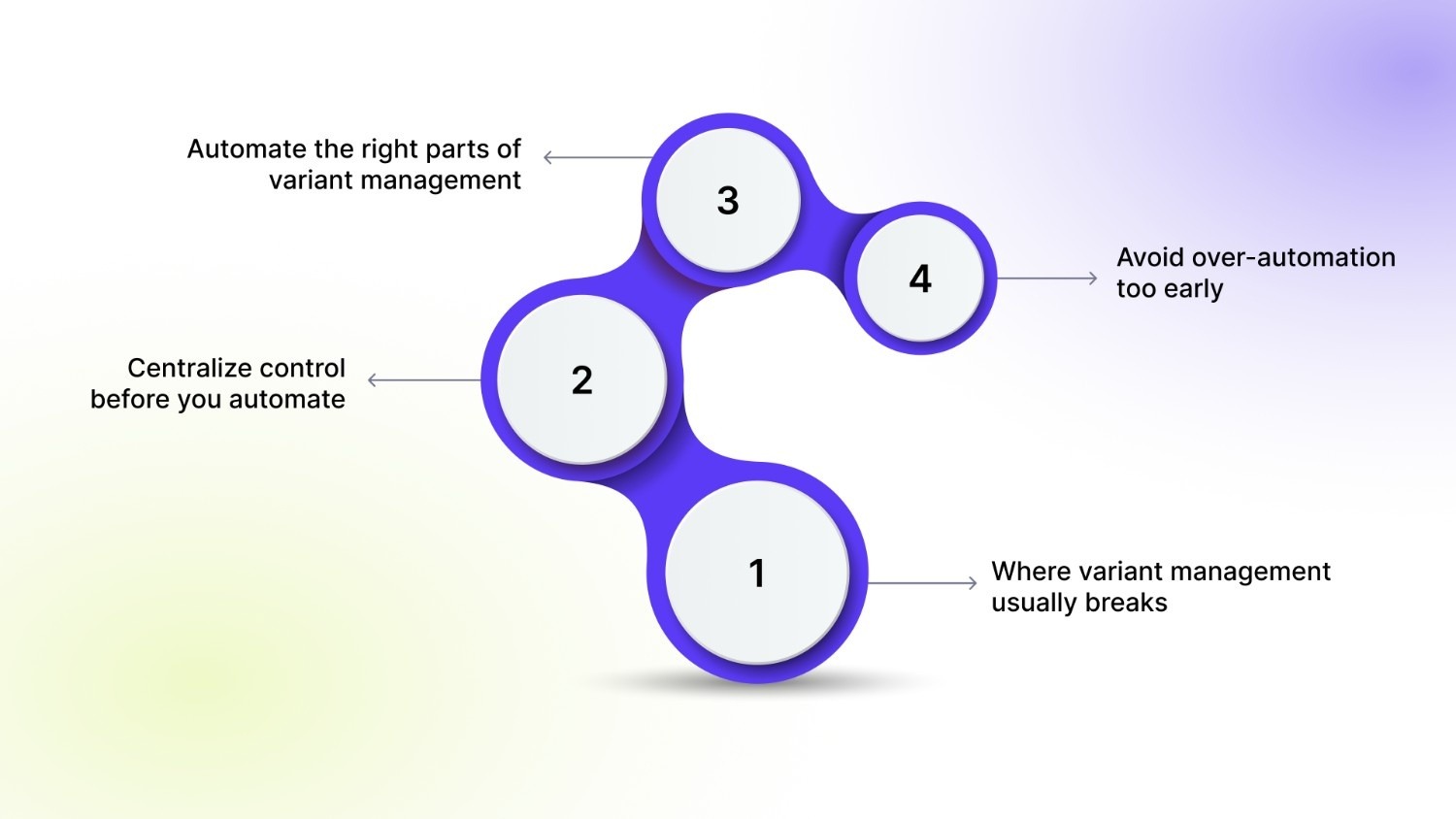
Variant data rarely lives in one place. It moves between design tools, ERPs, inventory systems, and sales channels like Shopify.
Every handoff introduces risk, and as catalogs grow, those risks multiply.
When variant data isn’t consistent, small issues quickly turn into operational problems.
Where variant management usually breaks
Most breakdowns happen during updates and handoffs:
- Variant changes applied in one system but not synced elsewhere
- Availability mismatches between internal tools and storefronts
- Manual re-entry creates small errors that spread across systems
A single outdated variant can trigger overselling, order cancellations, or production delays. At scale, these issues affect both margins and customer trust.
Centralize control before you automate
Strong variant management starts with a clear source of truth.
Successful teams:
- Maintain one system where variant definitions are owned
- Sync changes automatically across connected tools
- Limit manual edits outside core workflows
This also means ensuring that variant data updates don’t slow down storefront performance.
For Shopify merchants, this is where tools like StarApps add value by ensuring variant updates and automation logic don’t create storefront inconsistencies as catalogs expand.
Automate the right parts of variant management
Once variant data is clean and consistent, automation becomes a real advantage.
The goal isn’t to replace people, but to remove repetitive, error-prone tasks.
Automation is most effective when applied to:
- Creating only valid variant combinations
- Applying pricing and availability rules consistently
- Flagging unusual sales or inventory patterns early
- Preventing unsupported variant combinations from being sold
This reduces manual work and allows teams to focus on planning instead of constant corrections.
Avoid over-automation too early
Automation only works when rules are clear.
If variant logic is messy, automation simply scales mistakes faster. Fix structure first. Automate second.
As catalogs grow, prioritizing the right variants becomes just as important as managing them correctly.
Manage High-SKU Catalogs Without Losing Control
Managing a high-SKU catalog doesn’t fail all at once. It slips, slowly, as complexity grows faster than systems can keep up.
More variants mean more decisions, more data, and more room for small errors to turn into costly problems.
Without the right structure and controls, teams spend more time fixing issues than planning ahead.
This is where disciplined variant management becomes the difference between scaling smoothly and constantly playing catch-up.
Prioritize variants that matter
Not every variant deserves the same level of attention.
In high-SKU catalogs, trying to manage everything equally quickly leads to wasted effort and missed opportunities.
Prioritizing the variants that drive the most demand, revenue, or operational risk helps teams focus on what actually moves the business forward.
High-performing teams continuously:
- Identify top-selling variants
- Track margin contribution by variant
- Focus planning attention where impact is highest
This ensures resources go to combinations that actually drive revenue.
Actively reduce low-value variants
Variants that rarely sell:
- Increase carrying costs
- Complicate forecasting
- Slow down decision-making
Regular cleanup keeps catalogs healthy and manageable.
This discipline is a core part of effective variant management, especially in fashion, electronics, and home goods manufacturing.
Operational discipline must extend to the customer-facing side as well.
Why Variant Management Directly Affects Customer Experience
Customers never see your internal systems, but they feel the effects of variant management every time they shop.
When variants are clear, accurate, and available, buying feels easy and confident. When they’re not, confusion and frustration set in fast.
Strong variant management ensures customers see the right options, accurate stock levels, and reliable delivery promises, turning operational discipline into a better shopping experience.
When variant data is messy:
- Shoppers see unavailable options
- Filters don’t work correctly
- Product pages feel confusing
- Trust drops quickly
For brands selling on Shopify, this impact is immediate. Variant logic feeds directly into storefront UX.
Clean variants improve conversion
When variants are:
- Clearly organized
- Accurately available
- Fast to load
Customers make decisions faster and abandon carts less often.
A good example is IKEA.
IKEA sells products with multiple variants based on size, color, material, and region.
When variant data is managed well, customers can easily see which combinations are available in their local store or for delivery.
Stock levels update accurately, and customers know exactly what they’re buying before checkout.
When variant management breaks down such as showing a color or size that’s unavailable, customers experience disappointment, canceled orders, or delayed deliveries.
IKEA has invested heavily in structured variant data and inventory visibility to avoid this, because even small variant errors at scale can impact millions of customers.
This shows how behind-the-scenes variant management directly shapes trust, clarity, and confidence on the storefront.
This is where backend discipline meets frontend performance.
Strong operations still need the right performance layer to succeed online.
How StarApps Strengthens the Storefront Experience

StarApps Studio focuses on the part of variant management that customers interact with most, the product page.
As variant counts grow, many Shopify themes struggle to keep option selection fast, clear, and reliable.
StarApps is built to support these complex setups without adding friction.
It helps Shopify stores:
- Display variant options in a structured, easy-to-scan layout
- Ensure variant changes load instantly without slowing the page
- Maintain consistent behavior across desktop and mobile
- Handle large catalogs without compromising storefront performance
For manufacturers and hybrid brands selling on Shopify, this means operational complexity stays out of sight.
Customers experience a clean, predictable buying flow, even when products have many configurations.
Instead of reducing variant options to protect speed or UX, StarApps allows stores to scale product choice while keeping storefront interactions fast and dependable.
If your Shopify store manages complex product variants, StarApps helps keep the buying experience smooth as your catalog grows.
When variant structure, inventory planning, and storefront execution stay aligned, scaling no longer introduces risk, it creates momentum.
Final Thoughts
Product variety isn’t going away.
Customers expect choice. Manufacturers need control.
Strong variant management allows businesses to scale product offerings without sacrificing accuracy, speed, or customer experience.
It connects planning, production, inventory, and ecommerce into one coherent system.
And when those variants reach the storefront, performance matters just as much as precision.
Explore how StarApps supports high-variant Shopify stores by keeping product experiences fast, dependable, and conversion-friendly as complexity grows.
FAQs
1. What is variant management in manufacturing?
Variant management is the system of organizing and controlling product options (size, color, material) to streamline production and sales.
2. Why is variant management important for Shopify stores?
Proper variant management ensures accurate inventory, smooth storefront experiences, and fewer errors as catalogs grow.
3. How can AI tools help with variant management?
AI helps forecast demand, automate repetitive tasks, and prioritize high-value variants for more efficient operations.
4. Can StarApps help manage complex product variants?
Yes. StarApps optimizes variant-heavy Shopify stores by keeping product pages fast, intuitive, and reliable for customers.
5. What are the risks of poor variant management?
Without structure, manufacturers face stockouts, overstock, errors in reporting, and a poor customer shopping experience.
Heading

End-to-end traceability
To ensure regulatory compliance, you must have a complete overview of your products from production to shipping. Book a demo to see how Katana can give you full visibility of your operations.



.png)

.svg)

.svg)

.svg)
.png)